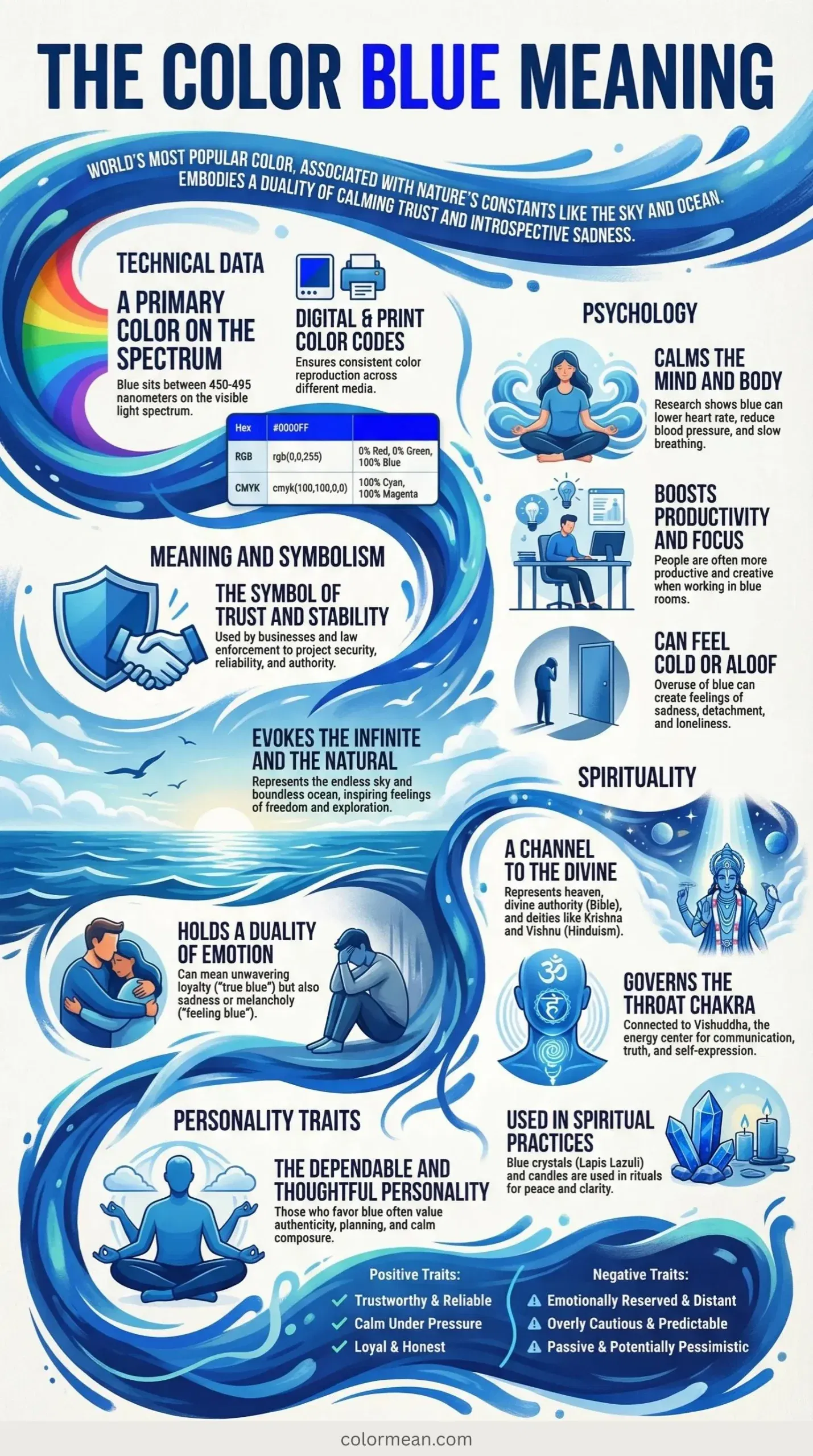
Blue Isn’t Just a Color—It’s a Universal Constant.
Few colors stop us in our tracks like blue. It stretches across the sky. It hides in the ocean depths. Moreover, a single glance can calm our minds. Blue does not shout. Instead, it resonates. From ancient royalty to modern tech giants, it remains the world’s most universally loved hue.
But why? What makes blue more than just a color? It is a symbol of trust, peace, and even melancholy. This deep dive explores blue’s psychological impact and spiritual symbolism. It also covers its historical roots and cultural meanings. Finally, we will look at its practical uses across industries.
Understanding blue gives you a powerful lens into human behavior. This is true whether you are choosing a paint shade or designing a logo.
Key takeaways
- Blue symbolizes trust, calm, intelligence, and stability. These traits explain its heavy use in corporate branding and healthcare environments.
- In spirituality, blue connects to divine communication and inner truth. It is also linked to the throat chakra, which governs self expression.
- From a psychological perspective, blue lowers heart rate and reduces stress. However, research from color psychology indicates overuse can trigger sadness or emotional detachment.
- Throughout history, blue was rare and expensive. It was reserved for royalty and religious figures until synthetic dyes made it widely accessible.
- Across cultures, blue carries varied meanings. It represents protection in the Middle East and mourning in parts of Asia. Additionally, it signifies holiness in Christianity and Hinduism.
What is the color blue?
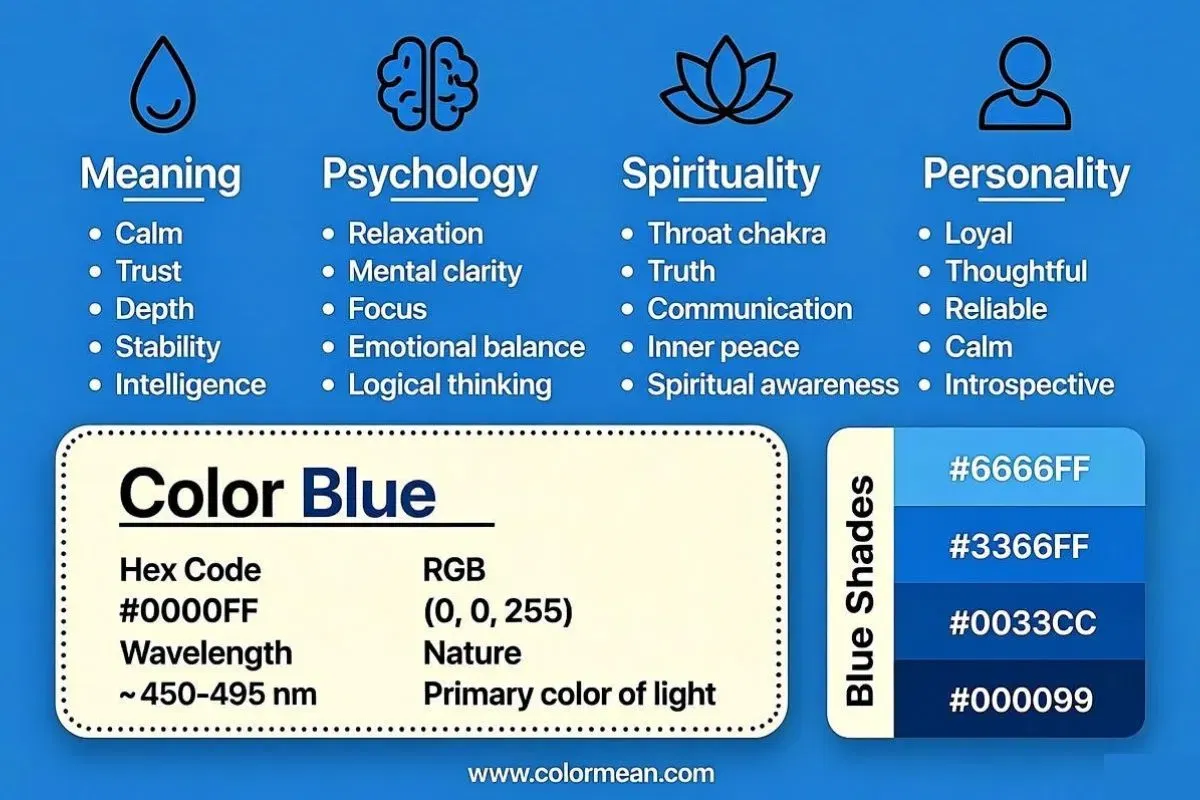
Blue sits between green and violet on the visible light spectrum. Its wavelengths range from approximately 450 to 495 nanometers. It is a primary color in both the RGB (light) and RYB (traditional art) color models. This means it cannot be created by mixing other colors, but it can create many others.
In nature, blue appears less frequently than red or green. True blue pigments in plants and animals are rare. For instance, a 2003 study in PNAS notes most natural blues come from structural coloration, not pigment. This means light scattering creates the color, as seen in bird feathers or butterfly wings.
Designers use specific codes to reproduce blue accurately:
- Hex Code: #0000FF
- RGB Code: (0, 0, 255) – for digital screens.
- CMYK Code: (100, 100, 0, 0) – for print materials.
From the icy pastel of Sky Blue to the deep, green-leaning Teal, blue’s popular shades each carry a distinct mood. The spectrum continues with the vibrant Electric Blue, the rich Navy, and the serene Cerulean, proving blue is remarkably versatile.
History of the color blue
For much of human history, blue was nearly invisible. Ancient languages like Greek, Chinese, and Hebrew lacked a distinct word for blue. Homer famously described the sea as “wine dark.” Egyptian texts referenced green and black but not blue. This is despite their early mastery of a vivid synthetic pigment.
They created Egyptian blue around 2500 BCE. It was made from silica, lime, copper, and alkali. Egyptians used this rare pigment in tomb paintings and sacred artifacts. Consequently, they linked blue to the divine and the afterlife. For instance, the sky god Amun and the creator god Ptah were often depicted with blue skin. This symbolized the heavens and rebirth.
However, blue remained obscure outside Egypt. Romans considered it a barbaric color. Furthermore, medieval Europeans associated it with peasants. This perception lasted until the 12th century.
Everything changed with the cult of the Virgin Mary. As devotion grew, artists began painting her robes in a deep, luxurious blue. This color came from ultramarine pigment. Ultramarine was ground from precious lapis lazuli stone imported from Afghanistan. In fact, this stone was more valuable than gold.
Therefore, wearing or depicting blue became a sign of holiness, purity, and high status. By the Renaissance, blue had climbed completely from obscurity to nobility.
The 18th century introduced Prussian blue. It was the first modern synthetic pigment. This discovery revolutionized both art and industry. Then in 1826, chemists created synthetic ultramarine. This finally made the color affordable for everyone.
Suddenly, blue was everywhere—in denim and flags. The color of heaven became the color of everyday life.
Interesting facts about the color blue
- Blue is the world’s favorite color. Global surveys across more than 60 countries consistently rank blue as the most preferred hue. This preference is especially strong among men.
- There are almost no natural blue foods. Foods like blueberries get their color from anthocyanins. These pigments shift with pH. True blue pigments are exceptionally rare in nature.
- Blue eyes are a genetic mutation. Research indicates all blue-eyed people share a common ancestor. This ancestor lived between 6,000 and 10,000 years ago. The trait results from reduced melanin in the iris.
- The sky is not actually blue. It appears blue due to Rayleigh scattering. Shorter blue wavelengths scatter more in the atmosphere than longer red or yellow wavelengths.
- “Blue laws” originally had nothing to do with color. These were 17th-century Puritan regulations restricting Sunday activities. They were allegedly printed on blue paper, but the origin is still debated.
- Blue light affects sleep. Exposure to blue wavelengths from screens suppresses melatonin production. This disrupts circadian rhythms and makes it harder to fall asleep.
Symbolism and representation of blue
Blue represents duality. It is both serene and somber. It feels expansive yet isolating. This tension makes it deeply symbolic across many contexts.
In nature, blue stands for infinity. It calls to mind the endless sky and the boundless ocean. Therefore, it evokes feelings of freedom and exploration. For example, sailors historically wore blue for protection. Similarly, pilots often paint cockpit interiors blue to reduce eye strain.
In human emotion, blue captures introspection. The phrase “feeling blue” ties it to sadness. Conversely, “true blue” means unwavering loyalty. This contrast reflects blue’s ability to hold opposites like calm and cold.
In institutions, blue signals authority and trust. It is used in police uniforms and UN peacekeepers’ helmets. Major corporate logos like IBM and Ford use blue to convey reliability and professionalism.
In technology, blue is the default color of the digital age. Hyperlinks, app icons, and interface themes rely on blue. This is because it is easy on the eyes and universally accepted.
Meaning of the color blue in spirituality
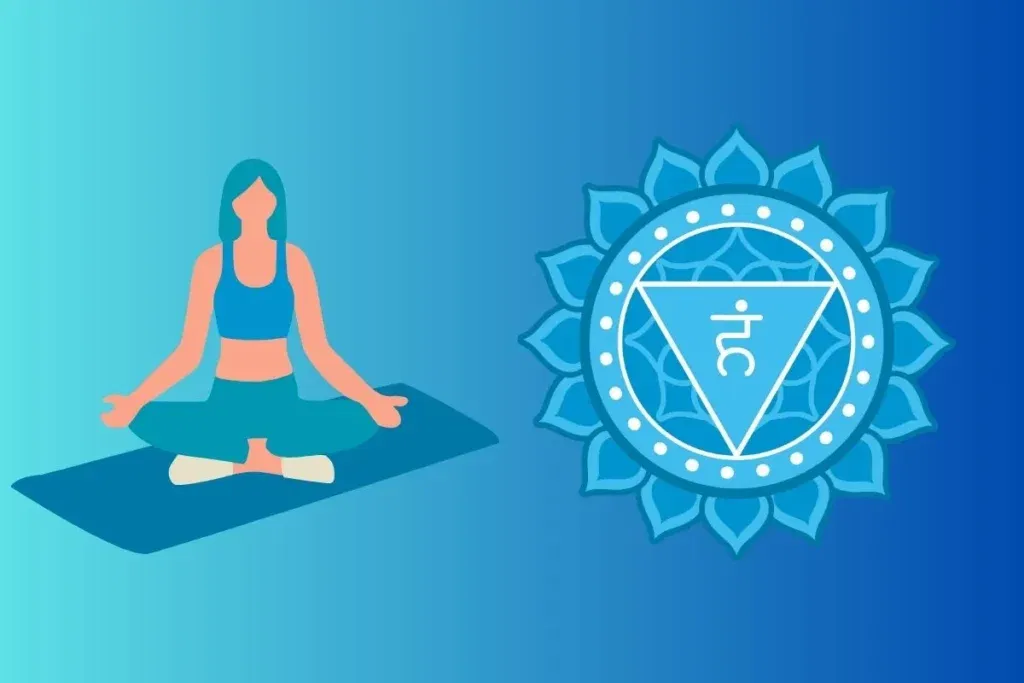
Spiritually, blue represents truth, intuition, and divine connection. It primarily bridges the earthly and the ethereal. Therefore, it acts as a direct channel for higher wisdom and inner clarity.
Blue and the chakras
Specifically, blue governs the throat chakra, known as Vishuddha. This energy center is located at the base of the neck. It is the seat of authentic self-expression and speaking your truth.
A balanced throat chakra enables clear and honest communication. Conversely, a blocked one can create silence or fear. Importantly, blue is used to heal and align this center. For instance, focusing on blue light during meditation can activate it.
Blue in auras
In aura interpretation, blue holds significant meaning. A soft, bright blue aura often indicates a calm and truthful person. It suggests someone who is a clear communicator.
Meanwhile, a muddy or dark blue aura may point to blocked self-expression. It can also indicate a fear of being heard. Therefore, seeing blue in an aura highlights themes of verbal integrity and spiritual communication.
Blue in spiritual practices
Many spiritual practices intentionally use the color blue. The goal is to harness its calming and clarifying vibrations.
Blue Crystals are particularly powerful. Lapis Lazuli is known as the stone of wisdom. It is believed to stimulate intellectual ability and enhance truth-seeking. Aquamarine is linked to calming communication and courage. Additionally, Blue Lace Agate soothes the throat chakra and eases anxious speech.
Blue Candles are used in candle magic and meditation. Lighting a blue candle can create a sacred atmosphere. This practice aids in rituals for peace, clarity, and honest conversation. It is also used to enhance psychic awareness during meditation.
The psychological meaning of blue

Psychologically, blue has a measurable influence on the mind and body. Research in color psychology consistently shows specific effects. For example, blue lowers blood pressure and slows breathing. It also reduces heart rate.
This happens because blue triggers the parasympathetic nervous system. This system controls the body’s “rest and digest” mode. Therefore, blue is a leading color for stress reduction.
Blue in environments
Many institutions use soft blues to create calm spaces. You will see it in hospitals, schools, and offices. Interestingly, some prisons have tested blue lighting to reduce aggression. Additionally, the color blue can create a perceived cooling effect. Product designers use this phenomenon in packaging, like for freezer compartments.
Potential drawbacks of blue
However, blue’s calmness has a flip side. Too much blue, especially in cold shades, can promote emotional detachment. It may also lead to feelings of loneliness. Studies note that people in blue rooms often feel less hungry. This is a key reason restaurants rarely use the color. Chronic exposure without warm accents can even lower motivation.
Blue and cognitive performance
Notably, blue can enhance certain types of thinking. One study exposed students to the color blue before exams. Those students scored higher on detail-oriented questions than those exposed to red. Red, conversely, boosts performance in physical tasks. Consequently, blue is an ideal color for libraries, study spaces, and analytical work.
Blue and perception
Furthermore, blue influences perceived trustworthiness. Social psychology experiments show that people wearing blue are rated as more reliable. They are also seen as more composed and intelligent compared to those wearing red or black. This subconscious bias explains why blue dominates professional attire and political campaigns.
Color blue personality traits

People who strongly identify with blue often exhibit a distinct blend of thoughtfulness and dependability. Their inner world runs deep, and they value authenticity over flashiness.
Positive traits
- Trustworthy: Blue personalities keep promises and honor commitments. Others see them as steady and reliable.
- Calm under pressure: They rarely panic. Instead, they analyze, plan, and respond with composure.
- Loyal: In relationships, they stand by friends and partners through challenges. Fairness matters more than drama.
- Excellent listeners: They offer space for others to speak, often providing thoughtful advice rather than quick fixes.
- Detail-oriented: Their precision makes them strong planners, editors, engineers, or caregivers.
Negative traits
- Emotionally reserved: They may struggle to express vulnerability, leading others to see them as distant or cold.
- Overly cautious: Their desire to avoid risk can stall decisions or prevent bold moves.
- Passive-aggressive tendencies: Rather than confront conflict directly, they may withdraw or give silent treatment.
- Pessimistic streak: In stress, they can spiral into “doom thinking,” focusing on worst-case scenarios.
- Perfectionism: Their high standards can frustrate team members or lead to burnout.
What does the Bible say about the color blue?
The Bible mentions blue over 50 times, mainly in Exodus, Numbers, and Ezekiel. Biblical blue is not tied to modern moods. Instead, it holds sacred and covenantal weight, symbolizing heaven, divine authority, and obedience.
For instance, God commands Moses to use “blue, purple, and scarlet yarn” for the tabernacle veil (Exodus 26:31). This blue was a specific dye called tekhelet. It came from the Murex trunculus snail, making it rare and precious.
This valuable dye was used in priestly garments (Exodus 28:6). It was also commanded for the fringes of Israelite robes (Numbers 15:38-39). The blue cord was a visual reminder of God’s commands and presence.
The prophet Ezekiel also saw a vision of a throne like “lapis lazuli” (Ezekiel 1:26). This deep blue stone linked God’s dwelling to the heavens. Later, Revelation describes the New Jerusalem’s foundations with sapphire, strengthening this heavenly association.
Notably, the Gospels do not directly mention blue. Yet, early Christian art adopted it from Jewish tradition to show divinity. Thus, blue’s theological echo endures as a bridge between earth and heaven.
Cultural and religious significance of blue
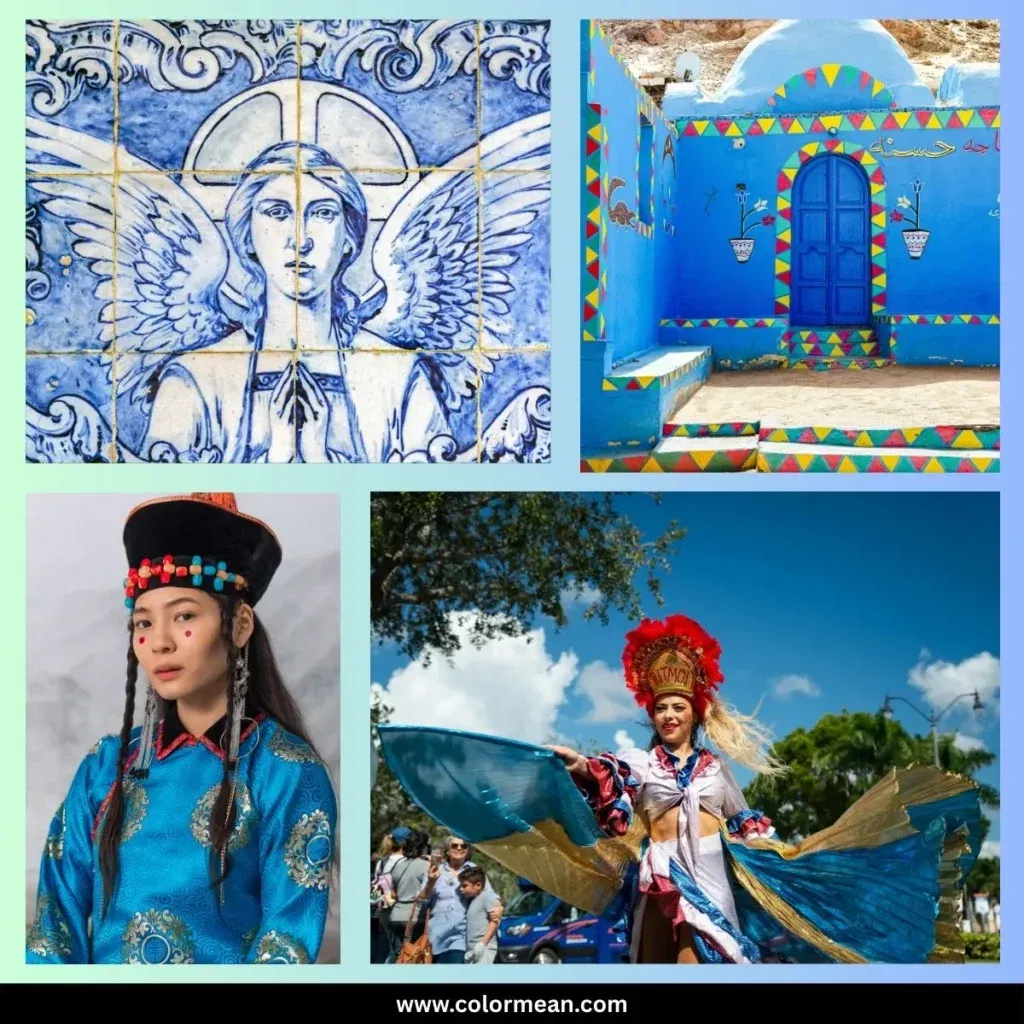
The cultural and religious significance of blue shifts dramatically worldwide. Each tradition assigns its own profound meaning to this versatile color.
For instance, in Ancient Egypt, blue represented the Nile, fertility, and rebirth. Consequently, gods like Amun were shown with blue skin to signify immortality.
Similarly, in Hinduism, deities like Krishna and Vishnu are depicted as blue. This symbolizes infinity, calm strength, and divine love.
In Islam, blue tiles dominate many mosques. The color is believed to ward off the evil eye and invite divine blessings. Furthermore, in Sufism, blue signifies spiritual yearning.
For Judaism, the lost tekhelet dye is a powerful covenant symbol. Remarkably, its use in prayer shawls is now being revived after 1,300 years.
In China, blue (qing) symbolizes healing and immortality, but can also imply infidelity. Meanwhile, in Japan, blue (ao) represents purity and calm, seen in indigo-dyed kimonos.
In West Africa, the Yoruba people’s indigo-dyed cloth (adire) symbolizes wealth and ancestral connection. The dye-making process is itself a sacred ritual.
For the Navajo people, blue is a sacred direction linked to the southwest, adulthood, and introspection. Blue corn is also a ceremonial staple.
In Greece and Turkey, bright blue “evil eye” amulets are ubiquitous. They are believed to deflect envy and misfortune. Finally, in Iran, blue domes on mosques reflect the sky, reminding worshippers of God’s vastness.
Dream interpretations of the color blue

Dreams featuring blue often reflect emotional states or spiritual openings. However, the specific context is critically important for an accurate interpretation.
To begin with, a clear blue sky typically signals peace of mind or a personal breakthrough. This often indicates that an internal conflict may be resolved.
Conversely, dark or stormy blue suggests suppressed sadness or unresolved grief. It serves as a nudge to process deeply buried feelings.
Similarly, calm blue water, such as an ocean, represents emotional depth and intuition. Therefore, swimming in it may signify you are ready to explore your inner world.
Transitioning to personal imagery, wearing blue clothes can point to a desire for trust or professionalism. This often reflects how you wish to be seen by others.
In contrast, seeing a blue light or aura is commonly associated with spiritual awakening. It can signify receiving guidance or developing psychic sensitivity.
Meanwhile, a blue animal, like a blue bird, may symbolize a message from your subconscious. It can herald hope or a long-awaited answer.
Furthermore, according to some dream psychology frameworks, recurring blue dreams may signal a blocked throat chakra. This is especially possible if you feel unable to speak up in waking life.
How to use the color blue
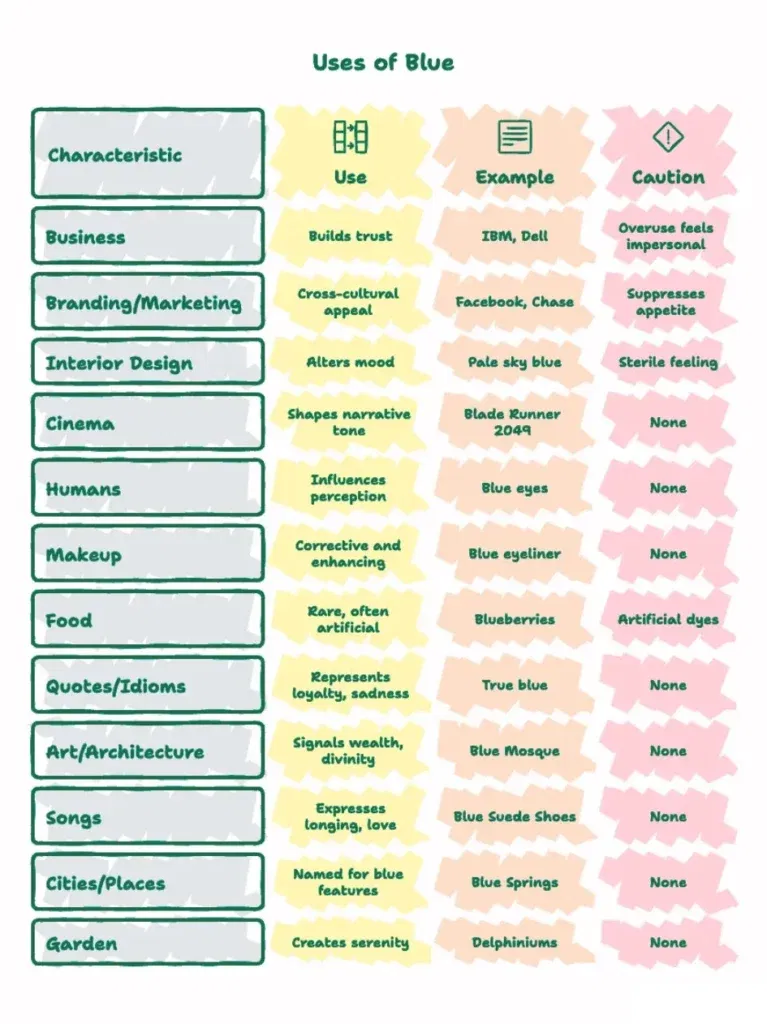
Blue is very versatile. This makes it one of the most strategically useful colors. Its emotional neutrality and high acceptance are key. Furthermore, its psychological effects allow it to serve many roles. It can show corporate authority or enable intimate self-expression.
1. Blue in Business
Blue dominates the corporate world. This is for a powerful reason. It builds instant trust. Companies in finance, technology, and healthcare lean on blue. It signals reliability, competence, and ethical conduct. For example, think of IBM, Dell, and American Express.
In business settings, blue improves productivity. It does this without overstimulation. Red triggers urgency and yellow can cause anxiety. Conversely, blue fosters sustained concentration. This is ideal for data analysis or client meetings. According to some studies, teams in blue-accented offices report fewer errors.
However, overuse can make a brand feel impersonal. To avoid this, businesses often pair blue with warm accents. For instance, PayPal uses orange and Snapchat uses yellow. This adds approachability while keeping credibility.
2. Blue in Branding and Marketing
Blue appears in over 30% of the world’s top brands. This is more than any other color. Its marketing power lies in cross-cultural appeal. It rarely offends and translates well globally. It also aligns with consumer desires like security and integrity.
Tech brands like Facebook use blue to suggest logical innovation. Banks like Chase use navy to convey financial stability. Healthcare brands use soft blues to evoke cleanliness.
Marketers also use blue to slow down decision-making. In retail, blue lighting can encourage thoughtful purchases. This is useful for high-consideration products.
One caution is that blue suppresses appetite. Fast food chains almost never use it for branding. If you sell food, use blue only for background elements.
3. Blue in Interior Design
Blue transforms spaces by altering mood and perceived temperature. Designers choose shades based on the desired impact.
Pale sky blue expands small rooms. It is ideal for bedrooms and promotes restful sleep. Navy blue adds sophistication to offices or dining rooms. Teal bridges cool and warm tones. It works well in creative studios.
Blue walls pair well with natural wood and white trim. Adding textural warmth prevents the space from feeling sterile.
Research shows practical applications. Hospitals use soft blue to reduce patient anxiety. Some schools use powder blue to lower aggression. In design, blue doesn’t just decorate. It can also heal.
4. Blue in Cinema
Filmmakers use blue to shape narrative tone and character psychology. Specifically, a cool color grade signals introspection, isolation, or dystopia.
For example, Blade Runner 2049 uses blue-lit interiors to emphasize emotional detachment. Meanwhile, The Revenant uses blue-tinged snowscapes to amplify harsh survival and spiritual solitude.
Conversely, warm versus cool lighting often contrasts characters. In The Godfather, Michael Corleone’s scenes shift from amber to blue as he loses his humanity.
Moreover, blue costumes carry specific meaning. Police uniforms signify authority. Hospital scrubs suggest neutrality. A lone character in a blue coat amid a gray crowd shows individuality. Ultimately, in visual storytelling, blue rarely lies. It shows what is beneath the surface.
5. Blue in Humans
Blue manifests in human biology and behavior beyond fashion.
Only about 8% of the global population has blue eyes, with the highest concentration in Europe. Some studies link blue eyes to higher pain tolerance and alcohol sensitivity.
Interestingly, blue veins are an optical illusion. Deoxygenated blood is dark red, but it appears blue under skin due to light scattering.
While blushing signals embarrassment, “feeling blue” correlates with lower serotonin levels. This is particularly relevant to Seasonal Affective Disorder (SAD) during darker winter months.
Research shows wearing blue influences perception. Job candidates in blue suits are often rated more competent. Doctors in blue scrubs are perceived as more caring than those in green. Thus, color becomes a social code.
6. Blue in Makeup
Makeup artists use blue with precision. Bold blue eyeliner makes a fashion statement.
However, everyday use favors subtle blue undertones. For instance, lavender or blue color-correcting concealers neutralize sallowness in fair skin.
In eyeshadow, navy adds depth without harshness. Icy blue creates futuristic looks. Additionally, many “cool-toned” red lipsticks have blue bases, making teeth appear whiter.
In editorial makeup, blue signifies otherworldliness. But in daily life, blue’s role is corrective and enhancing.
7. Blue Food
True blue foods are very rare in nature. Most get their hue from anthocyanins, which are pH-sensitive pigments.
Examples include blueberries and blue corn. Blue corn is rich in antioxidants and holds ceremonial importance in some Indigenous cultures.
Blue pea flower tea is a vivid herbal drink from Southeast Asia. It changes to purple with added lemon, acting as a natural pH indicator.
It is important to note that many blue foods use artificial dye. Some studies link dyes like Brilliant Blue FCF to hyperactivity in children. Consequently, many brands now seek natural alternatives like spirulina extract.
8. Blue in quotes and idioms
Language reveals our complex relationship with blue.
- “True blue” means loyal.
- “Out of the blue” means unexpected.
- “Feeling blue” means sad, possibly from sailor traditions.
- “Once in a blue moon” means a rare event.
These phrases show blue as both noble and melancholic.
9. Blue in art and architecture
Artists have long prized blue for its emotional range. Renaissance masters used expensive ultramarine to signal wealth and divinity.
Picasso’s Blue Period used monochromatic blues to convey poverty and suffering. Later, Yves Klein even patented his own shade, International Klein Blue (IKB).
In architecture, blue tiles define iconic structures like Istanbul’s Blue Mosque. Therefore, blue in design often elevates space toward the transcendent.
10. Songs with “Blue” in the title
Music uses blue to express longing, love, and introspection:
- Blue Suede Shoes – Elvis Presley (rebellion and style)
- Blue Monday – New Order (mechanical melancholy)
- Mr. Blue Sky – Electric Light Orchestra (joy after rain)
- Blue – Joni Mitchell (raw emotional vulnerability)
- Blue Velvet – Bobby Vinton (romantic nostalgia)
- Black and Blue – Van Halen (pain and resilience)
From jazz (“Blue Note” records) to country (“Blue Eyes Crying in the Rain”), the color frames music as emotional truth-telling.
11. Cities and places with “Blue” in the name
- Blue Springs (Missouri, Nebraska, and others): Named for mineral-rich waters with a bluish tint.
- Blue Mountains (Australia, Jamaica, India): Named for the blue haze created by eucalyptus oil or forest mist scattering light.
- Blue Earth (Minnesota): From the Dakota phrase makhá thad’é, referencing the blue-green clay in riverbanks.
- Blue Bell (Pennsylvania): Named after a historic inn with a blue bell sign.
12. Blue in the garden
Gardening with blue creates serenity. True blue flowers are rare, so gardeners prize them. Delphiniums offer tall spikes of sky blue. Hydrangeas turn blue in acidic soil.
Garden designers place blue flowers at the back of borders. Cool colors recede visually. This makes gardens feel larger. Pair them with silver foliage for a glowing moon garden.
Technical information
Technical information for blue brings clarity to how this color behaves across formats, accessibility, and design systems. You can explore precise color conversions, harmonies, shades, tints, tones, and test blue through contrast checking and color blindness simulation to ensure accurate and inclusive use.
Color Conversion
RGB Values & CMYK Values
Color Variations
Color Harmonies
CSS Examples
Final thoughts
Blue is not a loud color. However, it is a lasting one. Significantly, it does not dominate. Instead, it endures. From the first synthetic pigment in ancient Egypt to your smartphone screen, blue has shaped human culture. It provides stability in uncertainty. It offers a voice in silence. Furthermore, it creates calm in chaos.
Whether you wear it or paint with it, blue has an effect. If you dream of it or brand with it, this color invites action. Specifically, it asks you to breathe deeper. It encourages you to speak truer. Finally, it prompts you to look beyond the surface. Blue is the color of the sky above. It is also the color of the sea within. Consequently, it is limitless, reflective, and quietly powerful.
Our world races toward the next trend. In contrast, blue remains the anchor. Therefore, perhaps that is exactly what we need.