Maroon Isn’t Just a Color—It’s a Legacy.
Maroon does not shout. Instead, it whispers with authority. This color is deep, rich, and rooted in history. It commands respect without demanding attention.
For example, maroon appears in royal robes and modern boardrooms. It is also present in sacred rituals and on fashion runways.
Importantly, maroon carries a legacy of dignity, discipline, and depth. If red is passion, then maroon is wisdom forged through experience. This is not just a shade. It is a statement.
If you have ever felt drawn to maroon, this post will explain why. You will learn about the color maroon meaning.
Furthermore, you will discover its psychological impact and spiritual symbolism. Finally, you will explore its cultural roles and practical uses in life and design.
Key takeaways
- The color maroon is a dark red brown hue. It is created by adding black or gray to red. This process gives it a grounded, mature character.
- Historically, maroon symbolized nobility, sacrifice, and resilience. This is especially true among oppressed communities and academic institutions.
- In spirituality, maroon connects to grounding energy, inner strength, and disciplined focus. Consequently, it is often used in meditation and ritual wear.
- Psychologically, maroon evokes stability, confidence, and introspection. However, overuse can signal repression or emotional withdrawal.
- Across cultures and religions, maroon appears in Buddhist robes, African textiles, Christian liturgy, and academic regalia. Ultimately, it reflects reverence and tradition.
What is color maroon?
Maroon is a dark, reddish brown color positioned between crimson and burgundy on the color spectrum. Its name originates from the French word marron, meaning “chestnut,” which refers to the nut’s rich, brown red shell. Unlike the urgent energy of bright red, maroon radiates a calm, serious intensity.
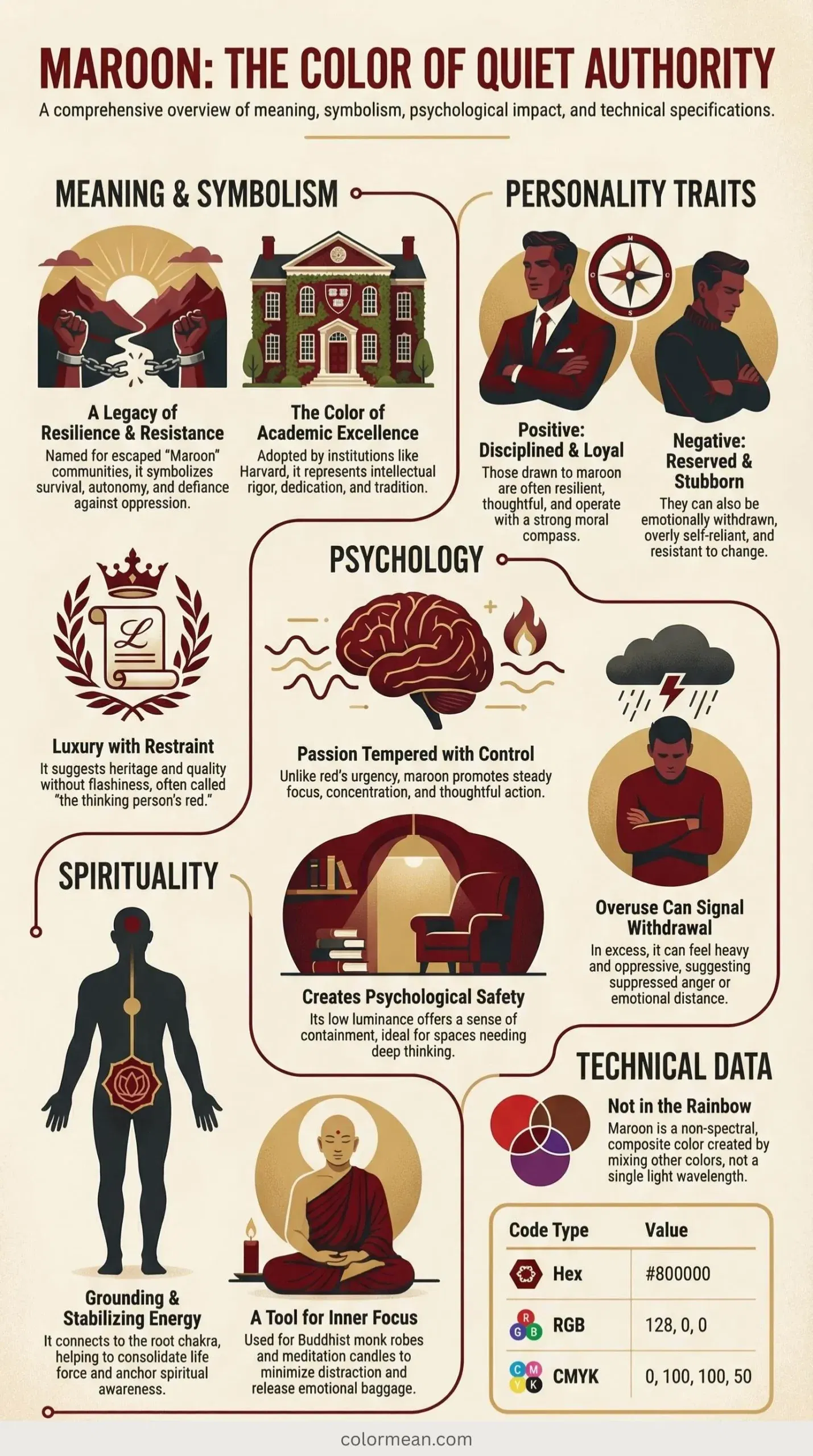
In color science, maroon is not a pure spectral color. This means it is not defined by a single wavelength of light. Instead, it is a composite shade created by darkening red with black or by mixing red with small amounts of blue and green. This composition gives it a grounded and substantial visual weight.
To reproduce maroon accurately in digital and print media, designers use specific color codes:
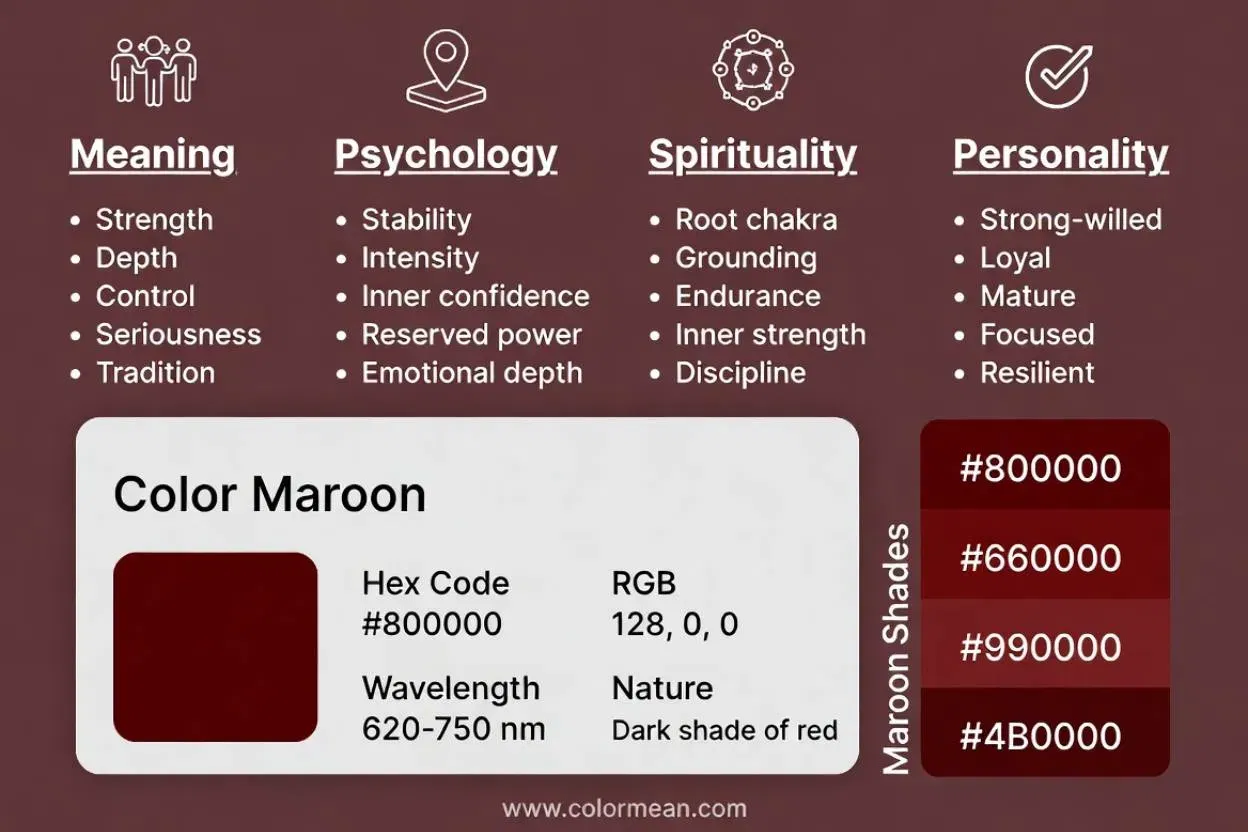
- Hex Code: #800000
- RGB Code: (128, 0, 0)
- CMYK Code: (0, 100, 100, 50)
However, maroon is far from a single note. From the brown dominant Tyrian maroon to the redder Oxford maroon, its popular shades each convey a distinct mood. The spectrum includes the bright Firebrick and the deeper Burnt Crimson, proving its incredible depth and versatility.
History of the color maroon
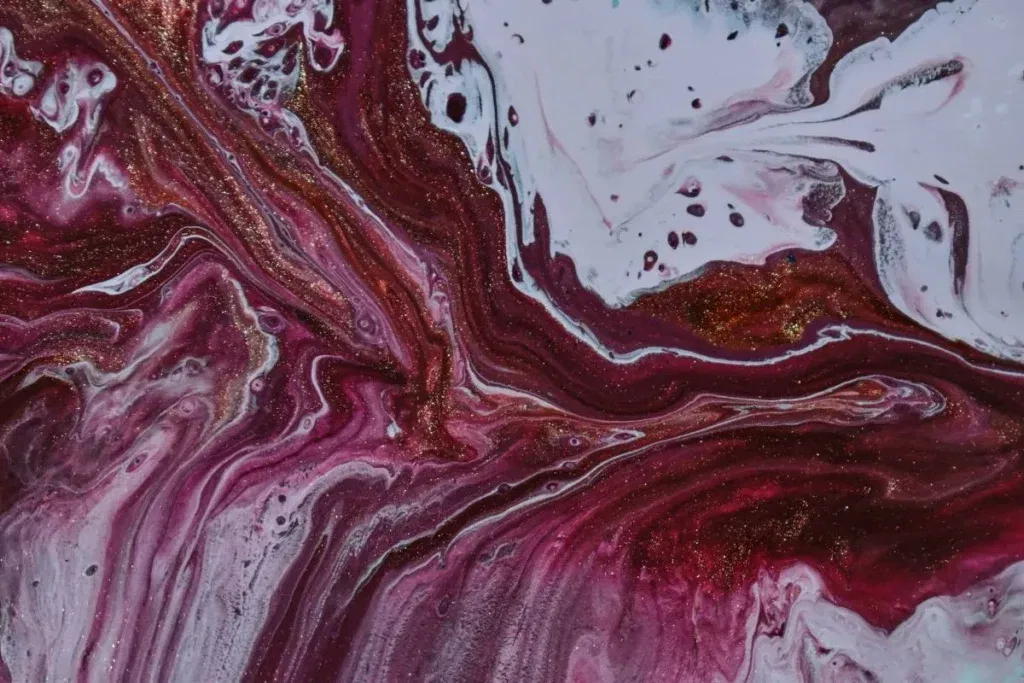
The story of maroon begins with people, not a pigment. The word “maroon” entered English in the late 18th century. It came from the French word “marron,” meaning chestnut. However, the color has much older roots in natural dyes and cultural resistance.
Deep red-brown hues were created using madder root over 5,000 years ago. This plant was cultivated across Europe, Asia, and North Africa. The Romans used it to dye military cloaks. Furthermore, medieval dyers refined it into darker tones. They overdyed the fabric with iron or walnut hulls. These processes added depth and permanence to the color.
Conversely, maroon’s most powerful association emerged far from Europe. In the Caribbean and Americas, “Maroons” were enslaved Africans who escaped. They formed independent communities in remote areas. Their name came from the Spanish word “cimarrón,” meaning “wild” or “untamed.” Over time, the term became linked to their resilient spirit. Eventually, it described the earthy color that mirrored their strength.
By the 19th century, maroon gained academic prestige. Harvard University adopted it as its official color in 1875. Reportedly, a student brought back a sun-faded crimson scarf from a rowing competition. The exposure darkened it to maroon. Other institutions like the University of Chicago followed suit. Consequently, maroon became a symbol of intellectual rigor and tradition.
In fashion, maroon surged during the Victorian era. Synthetic dyes like alizarin crimson were invented in 1868. These allowed consistent, affordable production of deep reds. Designers favored maroon for formal wear. It conveyed sophistication without ostentation. This quality still defines its use today.
Interesting facts about the color maroon
- Maroon is not in the rainbow. It is a non-spectral color. Research shows it cannot be made by a single light wavelength. It exists only through mixing, which gives it a complex visual presence.
- It is a major university color. Beyond Harvard, schools like Texas A&M and Tulane use maroon. It represents loyalty, heritage, and academic excellence.
- Maroon appears in national flags. The flag of Qatar features a maroon stripe. This honors the country’s historic dye production from sea snails. This industry once made the region wealthy.
- NASA uses it in astronaut gear. Mission patches and support uniforms sometimes incorporate maroon. It denotes specific teams or missions, blending professionalism with distinction.
- It is rare in nature. Few animals are truly maroon. However, some deep-sea creatures, autumn leaves, and minerals like hematite display similar tones. This is due to oxidation and light absorption.
- It is a “power neutral” in fashion. Unlike black, maroon adds warmth and personality while keeping formality. Designers often call it “the thinking person’s red.”
Maroon color symbolism
Maroon color symbolism is rich and deeply contextual. Importantly, it is not a fleeting trend. Its meanings are forged through centuries of human experience. Here are seven precise symbolic associations.
1) Resilience and resistance
Maroon directly references the Maroon communities of the Americas. These were communities of enslaved people who escaped and built independent, free societies. Their powerful legacy makes maroon a global symbol of survival and autonomy. Consequently, it stands as a lasting emblem of defiance against oppression.
2) Academic excellence
Maroon is a color of scholarly dedication. For instance, it is used in academic regalia at institutions from Harvard to historically Black colleges like Xavier University. Therefore, it represents disciplined intellect and a commitment to knowledge, not merely achievement.
3) Spiritual discipline
In Tibetan and Nepalese Buddhism, monks wear maroon robes. This color signifies renunciation and deep meditative focus. Research suggests darker colors can minimize visual distraction. Thus, maroon helps practitioners turn inward and cultivate mindfulness.
4) Luxury with restraint
Unlike brighter shades like gold or red, maroon conveys opulence without flashiness. Many high-end brands use it in packaging and interiors. Ultimately, it suggests heritage, quality, and understated confidence.
5) Maturity and responsibility
Maroon replaces the impulsivity of red with thoughtful action. In corporate settings, it often signals a leadership style that listens, plans, and acts with care. This connection is why it is frequently chosen for professional and formal contexts.
6) Sacred sacrifice
In Christian liturgy, maroon appears during Pentecost and feasts of martyrs. It honors those who gave their lives for their faith. As a result, the color is symbolically linked to blood, courage, and profound devotion.
7) Cultural identity
In West Africa, maroon-dyed fabrics like adire and kente carry ancestral messages. The dye process itself is significant. It often uses mud, roots, or indigo over a red base. Therefore, the color symbolizes transformation and identity forged through struggle.
The spiritual meaning of color maroon
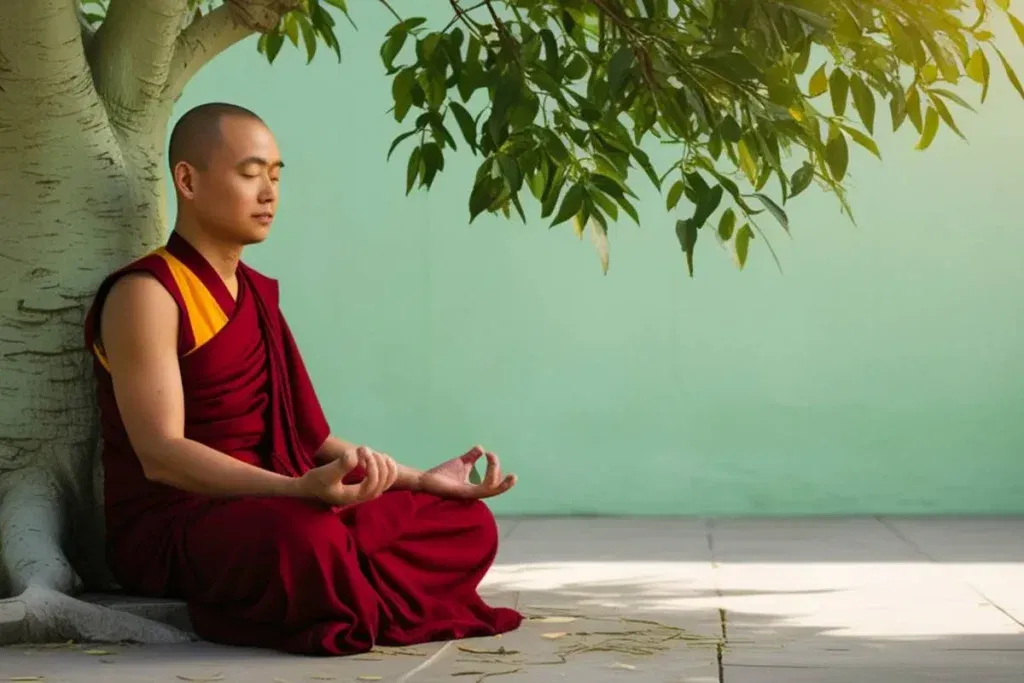
The spiritual meaning of color maroon centers on grounding, protection, and inner fire. While red energizes the root chakra with raw life force, maroon stabilizes that energy. Specifically, it consolidates and does not scatter.
In aura reading, a maroon aura suggests someone deeply connected to the physical world. Simultaneously, they are spiritually aware. Such individuals often serve as anchors in groups. They are typically calm under pressure, loyal, and quietly wise.
Maroon candles are used in spiritual practices focused on endurance. They are also used for ancestral healing and breaking cycles of fear. Lighting a maroon candle during meditation can help release emotional baggage. This often includes feelings tied to shame or failure.
Crystals that resonate with maroon energy include smoky quartz, garnet, and hematite. These stones enhance focus and shield against negativity. They also support emotional detoxification. Placing them near maroon fabrics can deepen their effect.
In yoga, visualizing maroon during grounding exercises is helpful. For example, use it in mountain pose or seated meditation. This practice helps draw energy from the mind into the body. Furthermore, it prevents spiritual bypassing, which is avoiding real-world pain.
Psychological meaning of color maroon
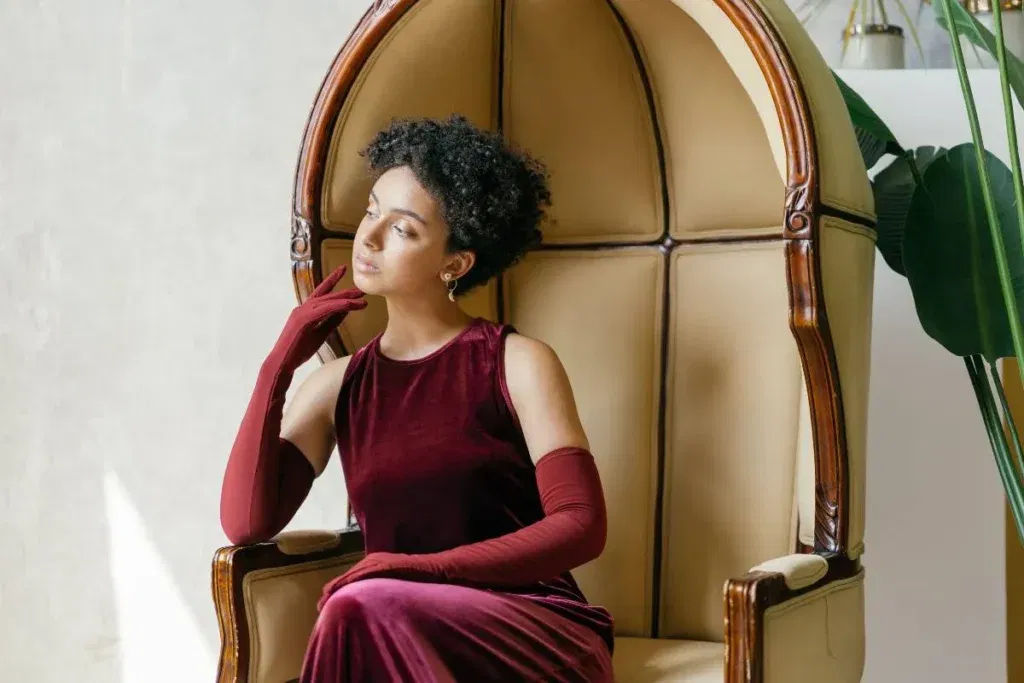
The psychology of color maroon shows a fascinating balance. Specifically, it mixes passion with control. Red often triggers excitement and urgency. Conversely, maroon tempers those impulses with clear maturity and restraint. Therefore, it activates the mind without overwhelming it.
Research in environmental psychology supports this. For example, studies indicate maroon walls in offices or libraries can increase concentration. Furthermore, they reduce impulsive decision making. Bright red can raise heart rate. However, maroon promotes a steady focus. Consequently, it is ideal for spaces needing deep thinking over speed.
In color therapy, maroon helps individuals feeling scattered or emotionally volatile. Its low luminance creates a visual “container.” This offers psychological safety. Importantly, people recovering from burnout often respond well to maroon environments. The color subtly communicates, “You can rest here and still be respected.”
However, too much maroon can backfire. In excess, it may signal emotional withdrawal or suppressed anger. A room drenched in maroon without contrast can feel heavy and even oppressive. Balance is key. Designers recommend pairing it with cream, soft gold, or warm gray. This maintains its dignity without suffocating energy.
Marketers deeply understand this duality. For instance, luxury car brands like Jaguar and Lexus use maroon interiors. This conveys sophistication and calm power, not aggression. Similarly, financial advisors often wear maroon ties.
Color maroon personality traits
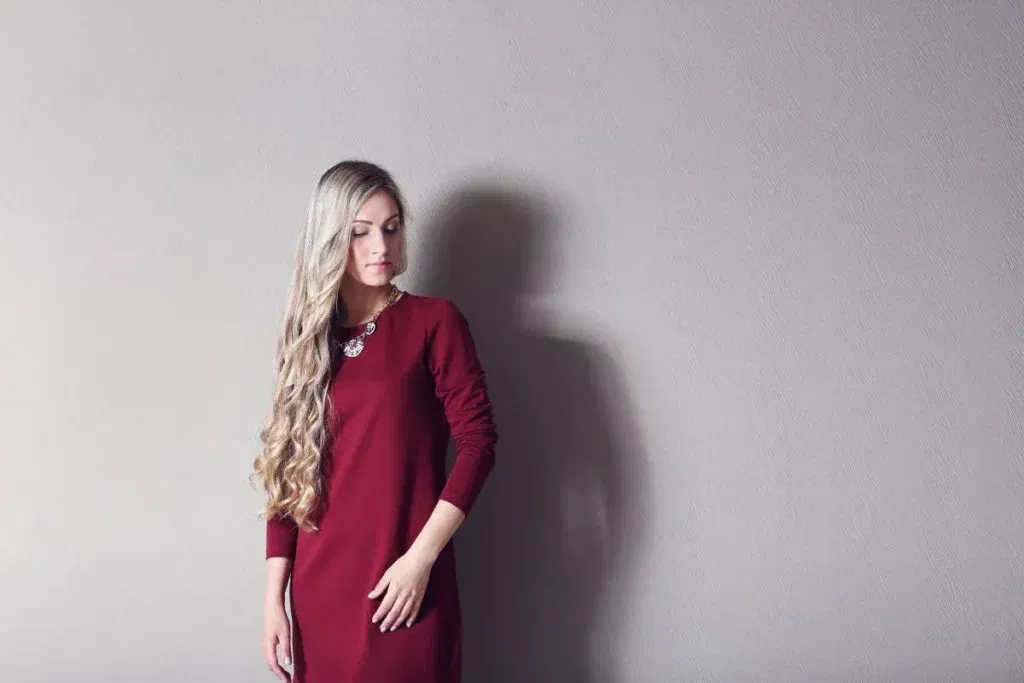
People strongly drawn to maroon often share distinct personality patterns. Research in color psychology suggests these preferences can reflect deeper cognitive and emotional frameworks. Consequently, these traits manifest in how they work, relate to others, and lead.
Positive traits
- Disciplined: Maroon personalities consistently set goals and follow through. They actively avoid shortcuts. Furthermore, they value earned success over instant wins. Studies on grit and perseverance, like those by psychologist Angela Duckworth, show this trait is a significant predictor of long term achievement across various fields.
- Loyal: Once committed to a person, cause, or partner, they stay dedicated. Their loyalty is not performative. Instead, it is quiet and consistent. This creates deeply secure, long lasting relationships.
- Thoughtful communicators: They often speak less but mean more. Before reacting, they observe, reflect, and choose words carefully. This deliberate style reduces misunderstandings and fosters more meaningful dialogue.
- Resilient under pressure: Crisis does not scatter them. In fact, they often become calmer and more strategic. As a result, they frequently step up as informal leaders during chaos. Their nervous system shows a high stress tolerance, according to some behavioral studies.
- Aesthetically refined: They prefer quality over quantity in possessions, clothing, and experiences. Visual or emotional clutter bothers them. This aligns with principles of minimalist psychology, which links curated environments to reduced anxiety and improved focus.
- Ethically grounded: They operate with a strong internal compass. Importantly, even when no one is watching, they act with integrity. This moral consistency builds a reputation of profound trustworthiness.
Negative traits
- Emotionally reserved: They may struggle to express vulnerability. Often, they fear it will be seen as weakness. Ultimately, this can create emotional distance in close relationships and hinder intimacy.
- Stubborn: Once convinced of a path, they strongly resist new input. This persists even when contrary evidence suggests change is needed. This rigidity can limit adaptability and growth in fast changing environments.
- Overly self-reliant: They rarely ask for help. Typically, they believe burdening others is disrespectful. However, this leads to unnecessary stress and isolation. It ignores the proven social and health benefits of mutual support networks.
- Pessimistic tendencies: Having often considered hardship, they sometimes expect the worst. Consequently, this defensive pessimism can dampen team joy, stifle innovation, and become a self fulfilling prophecy.
- Judgmental of flashiness: They may dismiss expressive or spontaneous people as shallow. Therefore, they risk missing valuable, diverse perspectives and opportunities for unexpected joy.
- Slow to forgive: While deeply loyal, they remember betrayals intensely. Rebuilding trust takes considerable time, sometimes longer than necessary. This can prolong personal conflict and prevent beneficial reconciliation, as noted in conflict resolution research.
What does the Bible say about color maroon?
The Bible does not mention “maroon” by name. Modern color terms did not exist in ancient Hebrew or Greek. However, it frequently references deep reds, crimson, and scarlet. These colors overlap significantly with maroon in both tone and symbolism.
In biblical context, red-based colors often represent blood, sacrifice, sin, and redemption. For example, Isaiah 1:18 says, “Though your sins are like scarlet, they shall be as white as snow.” The Hebrew term “tola’at shani” refers to a rich, insect-derived dye.
This dye was deep, lasting, and costly. Its intensity symbolized the gravity of sin. It also symbolized the possibility of cleansing.
Next, Exodus chapters 25 to 27 describe the Tabernacle’s curtains. They were woven with blue, purple, and scarlet yarn. These colors marked sacred space. Consequently, scarlet and darker reds like maroon signified divine presence and covenant.
In the New Testament, Revelation 17:3–4 depicts a woman dressed in purple and scarlet. She holds a golden cup, which symbolizes corrupt power. Conversely, Matthew 27:28 shows Roman soldiers mocking Jesus. They dressed Him in a scarlet robe, which foreshadowed His sacrificial death.
Historically, early Christian martyrs were often depicted in deep red or maroon robes. This was not to glorify death but to honor faithful witness. Furthermore, this tradition continues in liturgical vestments today.
For instance, Catholic and Orthodox churches use red, which can appear maroon in fabric. Specifically, they use it on the feasts of apostles and martyrs. Research into liturgical colors shows this practice dates back to at least the 4th century. It visually connects the sacrifices of the past with ongoing faith.
Cultural and religious significance of maroon
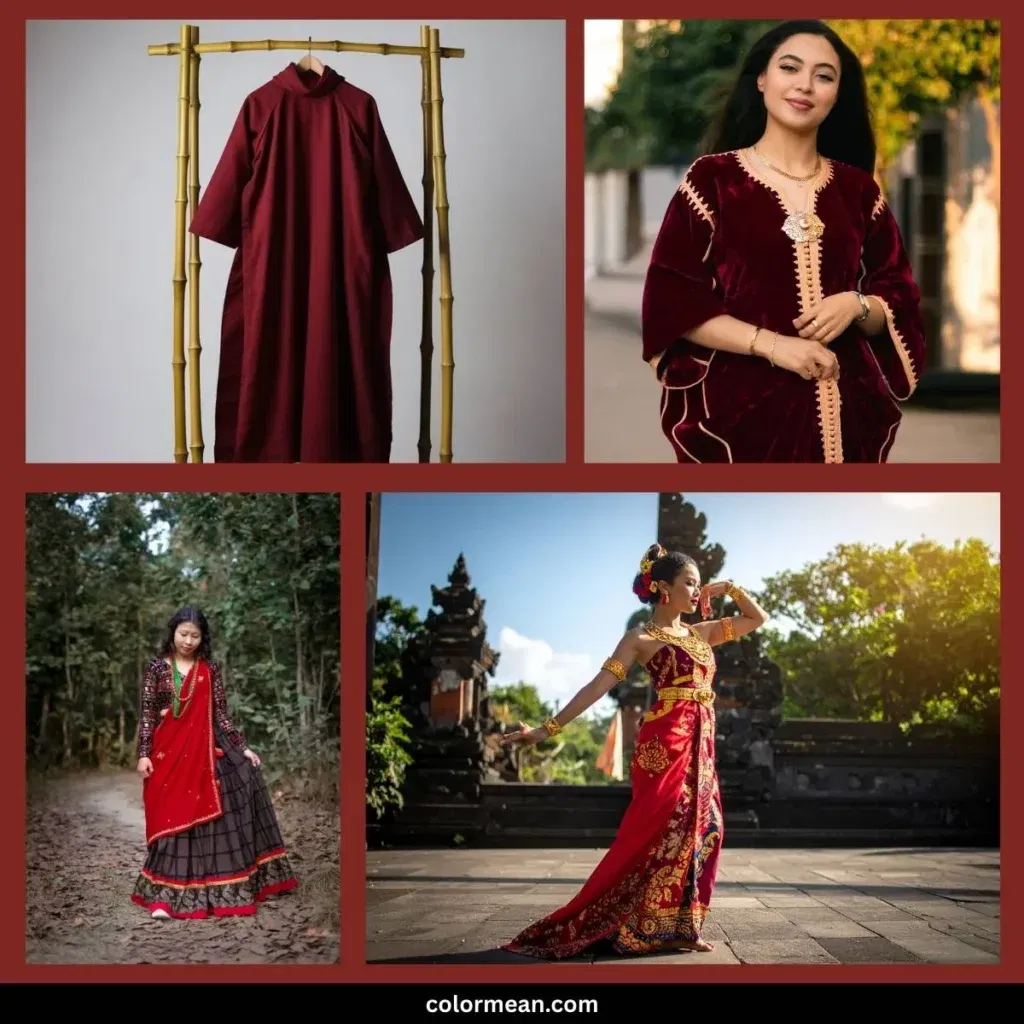
Maroon holds profound meaning across more than six global traditions. Its significance is deeply rooted in history, spirituality, and identity.
1) Buddhism (Tibet, Nepal, Bhutan)
Monks traditionally wear maroon robes dyed with natural pigments. Research indicates these colors were historically derived from safflower, lac, or madder. This specific hue signifies the renunciation of ego. Furthermore, it represents a commitment to the Middle Way, which avoids both indulgence and extreme asceticism.
2) Rastafarianism
Maroon appears within the Pan-African flag colors of red, gold, and green. Here, red stands for the blood of martyrs. Specifically, Rastafarians link this directly to the historic Maroon warriors of Jamaica. These communities successfully resisted slavery and colonial rule, becoming a global symbol of resistance and freedom.
3) West African cultures (Yoruba, Akan, Mandé)
Maroon dyed textiles like Nigeria’s adire and Mali’s bogolanfini are culturally vital. They carry proverbs, clan identities, and symbols for spiritual protection. The dye process itself often involves applying fermented mud over a red base. This technique mirrors the cultural theme of transformation through trial and patience.
4) Christianity (Catholic, Orthodox, Anglican)
As noted, deep red or maroon vestments mark sacred events. For example, they are worn during Pentecost to symbolize the Holy Spirit’s fire and on feast days for martyrs. Additionally, while Cardinals are known for scarlet, many now use maroon toned cassocks for daily wear. This color choice balances authority with humility.
5) Academic traditions (Global)
From Harvard University to the University of the West Indies, maroon academic gowns signal earned knowledge. In the Caribbean, this choice is particularly meaningful. It simultaneously honors European academic roots and the legacy of Maroon resistance, creating a powerful dual legacy of scholarship and liberation.
6) Hinduism
While saffron is dominant, some ascetic sects wear deep red brown robes resembling maroon. This is especially true during rituals honoring Shiva, the destroyer and transformer. Consequently, this darker red shade reflects detachment from worldly illusion, or maya.
7) Indigenous resistance movements (Americas)
Modern descendants of historical Maroon communities use this color for cultural affirmation. Groups like the Jamaican Maroons or Suriname’s Ndyuka people incorporate maroon into flags, clothing, and ceremonies. This usage affirms their cultural survival and ongoing sovereignty.
Dream interpretations of color maroon

Dreaming of maroon rarely relates to surface emotions. Instead, it signals inner maturity. This color often represents unresolved burdens or a powerful call to stand firm.
If you dream of wearing maroon clothing, you may be stepping into a demanding role. This could involve leadership, caregiving, or advocacy. Consequently, you feel ready for this responsibility, even if others do not yet recognize it.
Seeing a maroon room or object often reflects emotional containment. Essentially, you are holding something important inside. This could be grief, wisdom, or a secret. Therefore, the dream suggests you need a safe space to process these feelings.
When blood appears maroon instead of bright red, it typically relates to old wounds. Specifically, this dream symbol is not about new pain. Instead, it points to the necessary healing of a past injury that was buried.
Spotting a maroon animal, like a deer or bird, symbolizes grounded intuition. Your instincts are currently strong. However, you are wisely filtering them through experience rather than acting on impulse.
How to use the color maroon
Maroon’s depth makes it highly versatile, but only when applied with clear intention. Here is how to harness its power across various practical areas.
In business and professional settings
Maroon conveys trust, stability, and quiet authority. For instance, law firms and financial advisors often use it in their branding to signal competence without arrogance. However, avoid maroon for urgent calls-to-action. Research in color psychology suggests it slows decision-making rather than speeding it up.
In branding and marketing
Major organizations use maroon to communicate legacy and resilience. Brands like AARP and Purdue University employ it for its mature and historical weight. For readability, experts recommend pairing it with cream or soft white. You should also avoid neon accents, as they clash with maroon’s dignified nature.
In interior design
Use maroon to create intimacy on an accent wall or with library shelves. It pairs beautifully with brass and walnut wood. In bedrooms, it can promote restful sleep by lowering visual stimulation. However, never paint an entire small room maroon. Without ample lighting, it can feel oppressive and cave-like.
In cinema and visual storytelling
Filmmakers use maroon to signal moral complexity. In The Grand Budapest Hotel, maroon uniforms denote institutional loyalty. In Schindler’s List, a deep red coat symbolizes individual life amid tragedy. Therefore, this color rarely signifies simple good or evil. Instead, it implies layered humanity.
In fashion and personal appearance
People with warm skin undertones often look striking in maroon clothing, as it enhances golden or olive skin. Conversely, those with cool undertones should choose blue-based maroons to avoid sallowness. Natural maroon hair is rare but exists in deep auburn tones.
In makeup and beauty
Maroon lipstick or eyeshadow adds drama without garishness. It suits evening events and artistic expression. On fair skin, use a sheer application. On deeper skin tones, a bold application is striking. Avoid pairing it with heavy black liner; instead, use bronze or taupe for harmony.
In food and nutrition
Many maroon foods are rich in health benefits. For example, red kidney beans, beets, and black berries carry this hue. These foods are often rich in antioxidants like anthocyanins, linking the color to health and longevity in culinary presentation.
In culture, quotes, and idioms
Few common idioms use the word “maroon” directly. However, phrases like “blood runs deep” echo its symbolic meaning. Literary quotes often describe maroon as “the color of old courage.” Its absence from casual speech reinforces its association with seriousness.
In art and architecture
Historically, artists used maroon to denote importance. Renaissance painters used it for saints and scholars. In Islamic architecture, maroon tiles symbolize humility. Modern architects use maroon brick to visually anchor buildings, such as university halls.
In music and titles
Songs with maroon in the title are uncommon, which reinforces its serious tone. Taylor Swift’s song “Maroon” uses the color to represent a love faded from red to something quieter. When artists reference it, they typically mean endurance rather than fleeting romance.
In geography and nature
No major city is named “Maroon.” However, places like Maroon Bells in Colorado honor the word’s roots in nature and history. These locations often attract people seeking solitude or a deep historical connection.
In gardening and landscaping
You can plant maroon foliage for year-round depth. Good choices are coleus, Japanese maples, and heuchera. These plants offer rich texture and mood without relying on flowers. In autumn, many plants like oakleaf hydrangea naturally turn maroon, signaling seasonal transition.
Final thoughts
The meaning of maroon is not loud, but it lasts. It does not follow trends—it endures. From historical symbols of freedom to academic regalia, maroon stands for what remains after the noise fades.
So, it teaches that strength need not be flashy. It shows that tradition can be revolutionary. Furthermore, it reminds us that depth often speaks in whispers. Whether you wear it or simply notice it in autumn leaves, maroon invites quiet reflection.
Choose maroon when you want to communicate a powerful message: I am here. I have seen things. I stand firm.