White Isn’t Just a Color—It’s a Clean Slate.
Ever feel overwhelmed by the noise? White stops it all.
In a world shouting with color, white does not compete. Instead, it silences. This hue is the quiet pulse of purity, peace, and limitless possibility. At first glance, it might seem simple or even empty. But look closer.
Here is a secret: white contains every color. A prism proves this fact. It splits white light into a full rainbow. Consequently, this is profound power disguised as simplicity.
We see its call in a fresh snowfall. We see it in a wedding gown or a blank page waiting for your story. White is an invitation to begin again. That is precisely why it never goes out of style.
Ready to see white in a new light? This guide will explore its spiritual and biblical meanings. We will also examine the psychology behind its calming effect.
For instance, research in environmental psychology suggests white spaces can promote mental clarity and reduce cognitive overload. We will decode what dreaming of white signifies. Additionally, you will unpack its technical makeup in art and design.
Finally, you will find out its many uses in daily life. Consider this your complete journey to understanding the world’s most quietly powerful color.
Key takeaways
- The meaning of white centers on purity, clarity, and new beginnings. It also signifies spiritual illumination.
- Historically, white pigments evolved significantly. Early versions used natural chalk and toxic lead. Modern titanium dioxide is now the standard. This shift reflects advances in art, science, and safety.
- In spirituality, white is linked to the Crown Chakra, which represents divine connection. It is also essential in rituals for cleansing and peace, often using candles and crystals.
- Psychologically, white promotes calm and mental clarity. However, it can also feel sterile or isolating.
- Culturally, white has dual meanings. In Christianity, it symbolizes holiness and purity. Conversely, in Hinduism and other Eastern traditions, it often represents mourning and loss.
What is color white?
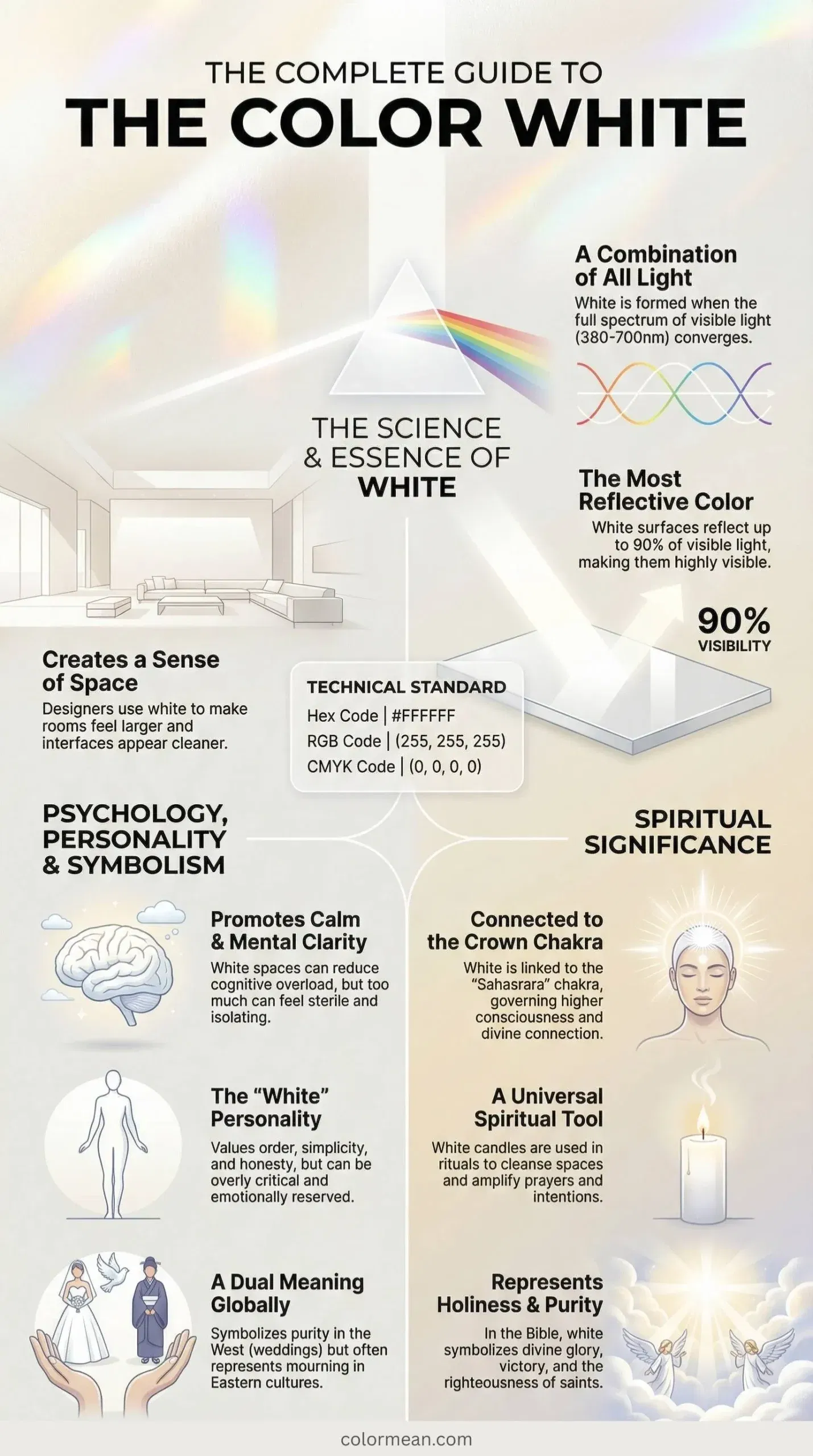
White is the combination of all visible light wavelengths. Importantly, it is not the absence of color. White sits outside the traditional color wheel because it has no single wavelength.
Instead, it forms when the full light spectrum, roughly 380 to 700 nanometers, converges. For instance, sunlight appears white for this very reason. However, passing it through a prism reveals its hidden rainbow.
In pigment science, white is an achromatic color, meaning it lacks hue. Unlike spectral colors, white surfaces reflect up to 90% of visible light. Consequently, this high reflectivity has practical effects. Research shows white clothing stays cooler in summer. Similarly, white roofs can significantly reduce building temperatures and energy use.
White creates spatial expansion. Unlike warm hues that advance or cool colors that recede, white opens space. Designers use this principle to make rooms feel larger and interfaces cleaner.
Furthermore, editors reference “white space.” This is not emptiness, but essential breathing room. Studies confirm that strategic white space guides attention and improves reading comprehension.

Technical standards for white vary by medium:
- Hex Code: #FFFFFF
- RGB Code: (255, 255, 255) – This mixes red, green, and blue light at maximum intensity on digital screens.
- CMYK Code: (0, 0, 0, 0) – In print, true white typically uses no ink, relying on the paper’s base color.
Despite its technical simplicity, white is not uniform. Subtle variations carry distinct emotional tones.
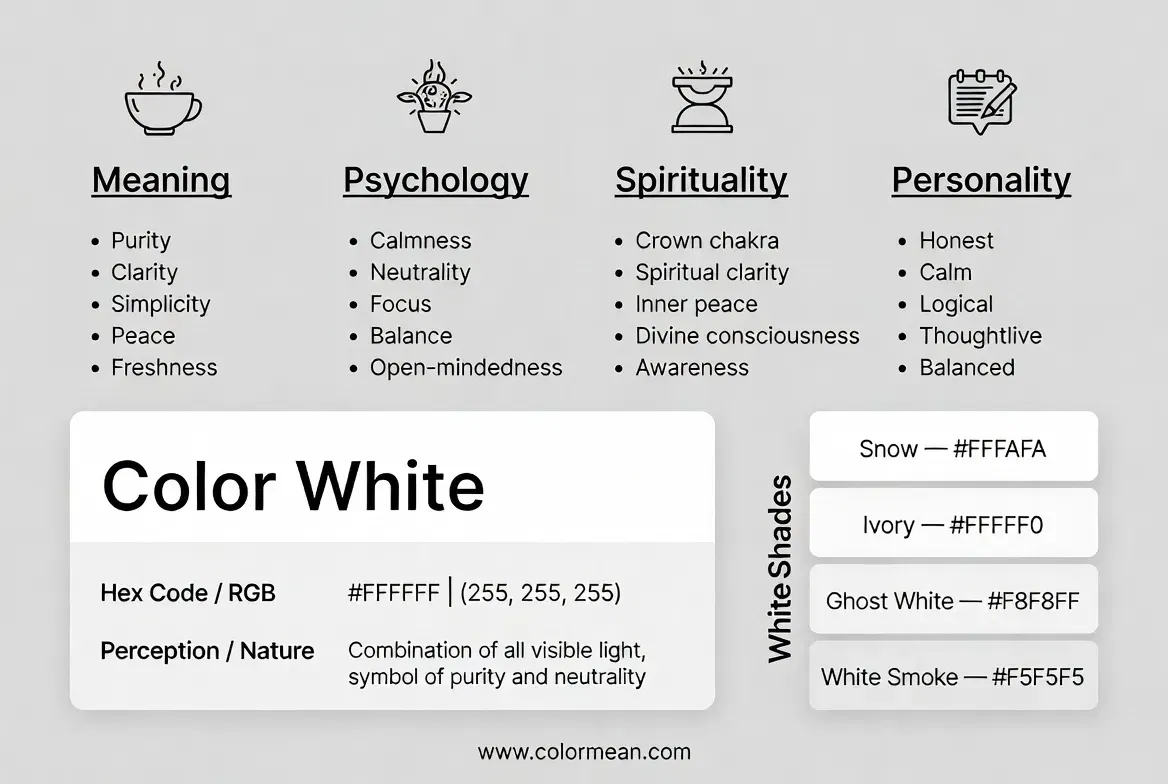
For example, ivory adds a warm, yellow hint for vintage elegance. Snow white feels crisp and modern, common in tech design. Bone white introduces a neutral-gray tone, grounding minimalist spaces.
History and interesting facts
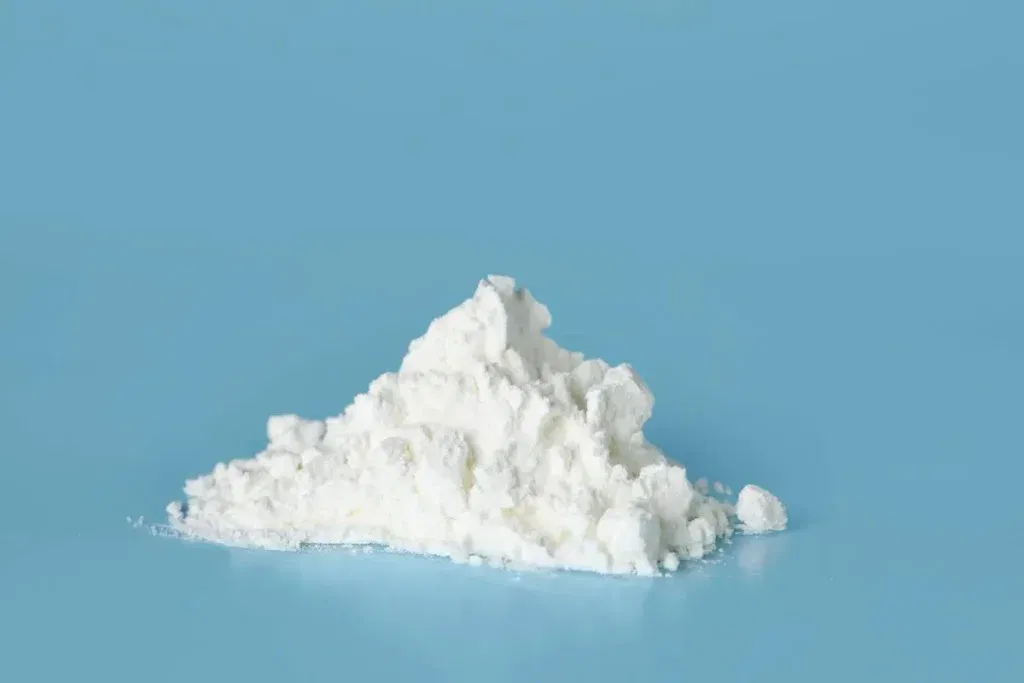
History of the color white
White pigment has ancient roots. Prehistoric humans used chalk and lime to paint cave walls. In ancient Egypt, white was sacred. It was linked to purity and sacred rituals. Priests wore white linen. Furthermore, white was used in temple decorations.
The Greeks and Romans valued white marble. They appreciated it not just for beauty but for its symbolic link to virtue and divine order. Roman brides wore white tunics called tunica recta. This tradition predates modern white wedding gowns by centuries.
During the Middle Ages, white became associated with holiness in Christianity. However, producing true white dye was difficult. Until the 18th century, white fabrics yellowed quickly. This was because bleaching relied only on sun and sour milk.
The Industrial Revolution changed everything. In 1785, chlorine bleaching was invented. This made white textiles brighter and more durable. Then came zinc oxide in the 1800s. It was followed by titanium dioxide in the 1920s. This is the strongest, safest white pigment ever created.
Today, titanium white dominates paints, plastics, and even sunscreen. It is so reflective that cities test white roofs to combat the urban heat island effect. White is now functional, sustainable, and scientific.
Interesting Facts About the Color White
- White is the most reflective color. It reflects up to 90% of visible light. Consequently, it is used in road signs and safety gear for maximum visibility.
- Polar bears are not truly white. Their fur is actually translucent. It only appears white due to light scattering within the hollow hairs.
- White noise gets its name from white light. Just as white light contains all frequencies, white noise contains all audible frequencies at equal intensity.
- The White House was not always white. It was originally gray sandstone. It was painted white in 1798 to cover scorch marks from a fire. The name officially stuck later.
- In Japan, white is the traditional color of mourning. This contrasts with many Western cultures, where black dominates funerals.
- White is the most common car color worldwide. It is chosen for its clean look and heat resistance, as it reflects more sunlight than darker colors.
Symbolism and representation
White carries layered meanings shaped by time, place, and purpose. It is never just blank. Instead, it signals transformation, truth, or transcendence.
1) Purity and Innocence
White is universally tied to moral and spiritual cleanliness. In Western weddings, brides wear white to symbolize virtue. Baptismal gowns and first communion dresses also follow this tradition. This link stems from white’s visual association with untouched snow.
2) Peace and Surrender
A white flag has signaled truce since ancient times. Its high visibility made it practical. More importantly, white conveys neutrality. The United Nations uses white in its emblem to reinforce global unity and peaceful intent.
3) New Beginnings
White represents open potential. A blank page or a fresh canvas evokes possibility. In design, white space invites creativity. In life, white clothing during rites of passage marks a transition.
4) Clarity and Truth
White reflects all light without distortion. Therefore, it symbolizes honesty and transparency. Legal documents are printed on white paper. Courtrooms often feature light colored walls to project fairness.
5) Spiritual Enlightenment
In many Eastern traditions, white signifies the highest spiritual state. For example, some Buddhist monks wear white during ceremonies. In Hinduism, white is worn during funerals. It symbolizes a release from worldly attachments.
6) Hygiene and Sterility
Hospitals and labs use white to signal cleanliness. Doctors wear white coats to project professionalism. This symbolism emerged in the late 19th century. It replaced black coats that hid stains but felt ominous.
7) Divine Presence
Finally, divine beings often appear in radiant white in religious texts. Angels and saints are described in brilliant white garments. The color suggests a holiness that is both awe inspiring and transcendent.
Meaning of the white color in spirituality

White represents the ultimate spiritual color. It does not belong to any single chakra. Instead, it transcends them all. Other colors connect to specific energy centers. However, white signifies the integration of the entire system.
In chakra theory, white is linked to the Crown Chakra (Sahasrara). This chakra is at the top of the head. It governs higher consciousness, universal connection, and enlightenment. An open Crown Chakra allows access to divine wisdom. Consequently, white light meditation is a common practice. This involves visualizing a soft white glow to activate this energy center.
A white aura is rare and powerful. It often appears around healers or people having spiritual awakenings. A pure white aura suggests complete alignment of body, mind, and spirit. Sometimes, white flickers at an aura’s edges. This indicates protection or purification.
Spiritual rituals frequently use white candles. Unlike colored candles, white candles are universal. They cleanse spaces and amplify prayers. Therefore, a white candle acts as a spiritual reset button.
Crystals reinforce these themes. Clear quartz amplifies energy and intention. Selenite cleanses negative vibrations. Moonstone connects to intuition and emotional balance.
Many traditions use white clothing during prayer. This signals openness to higher guidance. For example, Tibetan monks drape white scarves as blessings.
Psychological meaning of color white

White affects the mind before it registers as a color. It reflects all light, creating openness. Research indicates white environments can lower cognitive load. The brain accepts white as neutral ground.
This neutrality makes white a powerful psychological tool. White walls in therapy rooms minimize distraction. Whiteboards provide a blank stage for ideas.
However, too much white can feel sterile or isolating. Studies show it may cause feelings of emptiness. Designers often add warm textures to restore emotional warmth.
White triggers associations with cleanliness and order. Research confirms people wash hands more thoroughly in white bathrooms. Consumers see white-labeled products as more pure. Hospitals use white linens to build patient trust.
Moreover, white supports a cognitive reset. The brain sees it as a signal for a fresh start. This is why it is common in creative studios.
In summary, white calms mental noise. Used alone, it soothes. When overused, it numbs. When balanced, it empowers.
White color personality traits

People strongly drawn to the color white often reflect its symbolic qualities. Their personalities typically show clarity and simplicity. Research in color psychology frequently links white to purity and cleanliness. These individuals often hold themselves to high standards.
Positive traits
Principled
These individuals maintain firm moral boundaries. They deeply value honesty and expect integrity from others. Therefore, compromising on ethics feels like a personal betrayal.
Organized
For white personalities, order matters immensely. They excel in structured environments. Consequently, they plan ahead and maintain tidy spaces. Chaos typically drains their energy.
Peaceful
They actively avoid unnecessary drama. Conflict often feels messy to them. Instead, they seek diplomatic solutions. As a result, they frequently become mediators in groups.
Perceptive
By minimizing distractions, they notice subtle shifts. They easily read between the lines. For instance, they can sense unspoken tensions in a room.
Renewal oriented
They strongly believe in second chances. This applies to relationships and careers. Essentially, they encourage others to start fresh. A 2021 study in the Journal of Positive Psychology found that individuals with a “fresh start mindset” report higher well-being.
Minimalist by nature
They consistently choose quality over quantity. Their homes and schedules reflect intentional simplicity. Ultimately, this is about focus, not lack.
Negative traits
Overly critical
Their high standards can become judgmental. They may see nuance as compromise. Furthermore, they might view imperfection as failure.
Emotionally reserved
To maintain composure, they often suppress feelings. This can make them seem cold or unapproachable. It happens even when they care deeply.
Rigid
For them, flexibility is challenging. Deviations from a plan can cause anxiety. They often struggle with spontaneity and ambiguity.
Perfectionistic
The pursuit of flawlessness can paralyze action. They may delay projects waiting for perfect conditions. However, this standard rarely arrives.
Detached
In seeking neutrality, they can disconnect emotionally. Friends might feel analyzed rather than embraced. This is a common downside of their objective approach.
Avoidant of conflict
Their peace seeking can lead to passive behavior. Instead of addressing issues, they may withdraw. They often hope problems resolve on their own.
What does the Bible say about color white?
The Bible uses white over 75 times. It always carries spiritual weight. It never appears as mere decoration. Instead, white consistently represents holiness, victory, and divine presence.
For example, Revelation 3:4–5 records Jesus speaking to the church in Sardis. He says the worthy will walk with Him dressed in white. Furthermore, the victorious will also be clothed in white. Here, white garments symbolize moral purity and eternal reward.
Additionally, Revelation 7:9 describes a vast heavenly crowd. They wear white robes and hold palm branches. This scene represents believers from every nation. Therefore, the whiteness signifies their cleansing through faith.
Sacred moments also feature white. During the Transfiguration (Matthew 17:2), Jesus’ clothes became as white as light. This showed His divine glory. Similarly, angels at the tomb (Mark 16:5) and Ascension (Acts 1:10) wore dazzling white.
Moreover, white signifies divine authority. Daniel 7:9 describes God’s throne as “thrones of white.” This emphasizes divine justice and eternal authority.
White is also central in cleansing rituals. In Leviticus, priests wore white linen for sacrifices. Also, healed lepers were purified with white garments (Leviticus 14).
However, white is not automatic. It must be earned or granted. Revelation 19:8 explains the bride’s fine linen stands for the righteous acts of God’s people. Consequently, purity is shown as active, not passive.
Cultural and religious significance of the color white
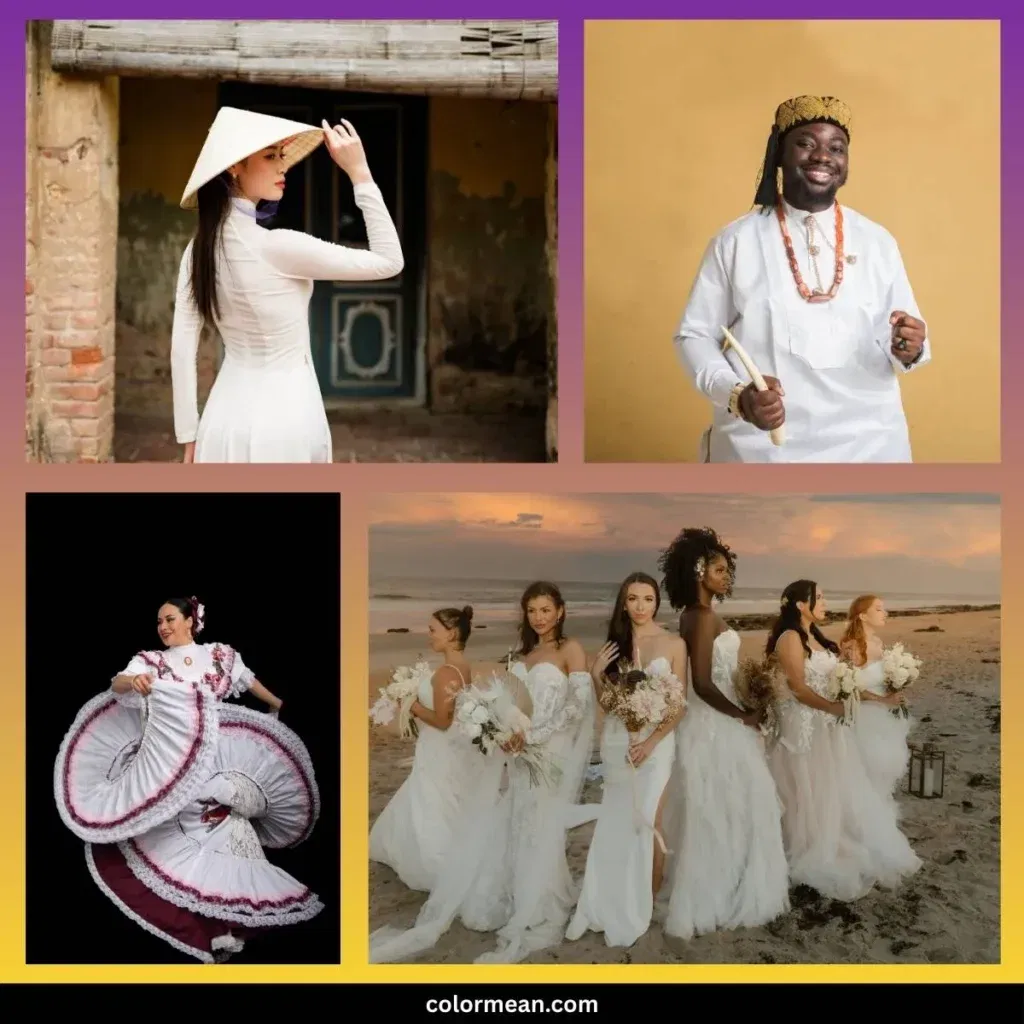
White’s meaning shifts dramatically across cultures. It can honor life or mourn death. Often, it does both at once. Its universality lies in its adaptability to human ritual.
1. Christianity
White symbolizes resurrection, purity, and joy. It is worn on major feast days like Easter and Christmas. Furthermore, clergy wear white robes during baptisms and celebrations. Historically, Pope Pius V permanently adopted the white cassock in the 16th century. This underscores humility and spiritual authority.
2. Hinduism
In Nepal and India, white is the traditional color of mourning. Widows often wear white saris. This signifies detachment from worldly life. Yet, white also denotes purity. Yogis wear white for purity of thought. Additionally, devotees offer white flowers to deities like Shiva.
3. Buddhism
Buddhists use white in rituals of peace and purification. In Tibetan tradition, white scarves (khata) are offered as blessings. Also, white cloths cover bodies in funerals. This aids the soul’s peaceful transition. Moreover, white represents the highest mental state free from desire.
4. Islam
White is essential for the Hajj pilgrimage. Pilgrims wear unstitched white garments called ihram. This practice symbolizes equality before God. It also represents the shedding of ego and material identity. The Kaaba in Mecca is often draped in white during specific rites.
5. Shinto (Japan)
Shinto priests wear pure white robes for ceremonies. Shrines feature white paper streamers (shide) to mark sacred space. Specifically, white symbolizes kiyome, or ritual purity. This is essential before approaching the kami (spirits). Traditional weddings may include white kimono elements.
6. Chinese culture
Traditional Chinese funerals use white extensively. White paper, clothing, and banners signal mourning. However, white also appears in festivals like Lunar New Year. In the Five Elements system, white represents metal. This denotes strength and precision.
7. Western secular traditions
White anchors modern rituals. Queen Victoria popularized the white wedding dress in 1840. Notably, this initially showcased wealth, as white fabric was expensive. Today, it is a global symbol of new beginnings. Similarly, white graduation gowns signify academic achievement.
8. Indigenous traditions
For some Native American tribes, white feathers symbolize divine messages and peace. The White Buffalo Calf Woman is a sacred Lakota figure. Her appearance, marked by a rare white buffalo, symbolizes hope and renewal.
Dream interpretations of color white

Dreams featuring white rarely signal emptiness. Instead, they point to clarity, transformation, or spiritual readiness.
Seeing white clothing often indicates a desire for moral renewal. Clean, flowing robes suggest a fresh start. Conversely, stained or torn clothing may reflect guilt.
A white room or space suggests a mental reset. The dreamer may be preparing to release old beliefs or habits. Therefore, it is a subconscious invitation to simplify.
White animals carry strong omens. A white dove represents peace after conflict. A white deer often signals a spiritual calling or major life turn.
White light is a very positive symbol. It frequently appears during grief or decision-making. Interestingly, many near-death experiences report a loving, all-knowing white light.
On the other hand, endless white landscapes can indicate emotional numbness. The dreamer may feel frozen or disconnected.
Dreaming of writing on white paper suggests ideas waiting to be voiced. A blank page, however, may reflect a creative block.
In all cases, context matters. White in dreams almost always relates to truth, cleansing, or transition.
How to use the color white
White is more than an aesthetic choice. It is functional, symbolic, and strategic. This guide explores twelve precise applications across different areas of life.
1) Color white in business
White conveys professionalism, efficiency, and transparency. For instance, law firms, tech startups, and medical offices use white to project trust and clarity. Furthermore, minimalist white spaces can reduce decision fatigue. A study in the Journal of Environmental Psychology suggests that simplified environments help people focus better. Consequently, clients can concentrate on services, not decor. For example, Apple Stores use vast white spaces to minimize distraction and focus attention on products. In corporate settings, whiteboard walls in white meeting rooms foster open collaboration and clear thinking.
2) Color white in branding and marketing
Major brands like Apple, Tesla, and Google use white to signal innovation, simplicity, and premium quality. Similarly, white packaging often implies clean, natural, or pure products. This is a common tactic in the skincare and organic food industries. For instance, many milk alternatives and yogurts use white cartons to emphasize purity. However, white alone can feel cold or sterile. Therefore, it is frequently paired with a warm accent color for balance and emotional connection. Research on color psychology confirms that white effectively creates a perception of space and modernity.
3) Color white in interior design
White expands small spaces and reflects natural light. As a result, it creates a calm foundation. Professional designers layer different whites, like ivory, chalk, and snow, to add visual depth and warmth. Additionally, white walls act as a neutral backdrop. This allows artwork, furniture, or greenery to become the main focus. In Scandinavian design, white is essential for creating bright, airy interiors during long winters. In retail, white dressing rooms are standard because they provide truer color reflection for clothing.
4) White color in cinema
Filmmakers use white to denote purity, isolation, or revelation. For example, in The Revenant, white snowscapes emphasize brutal survival. In contrast, the film Her uses white interiors to show a clean but emotionally sterile future. Moreover, white is traditionally used in cinematic heaven scenes or to indicate clarity and truth. In The Matrix, the white room where Neo meets the Architect represents a space of pure information and choice. Alternatively, overwhelming white can signify amnesia or oblivion, as seen in hospital scenes.
5) White color in humans
Historically, pale skin was incorrectly linked to nobility and leisure because it meant no outdoor labor. Today, “white” as a racial category is a social construct that varies globally. Meanwhile, white hair often symbolizes wisdom and age. In modern fashion, however, silver white hair is seen as a bold, intentional statement. Culturally, wearing white at weddings in Western societies symbolizes purity and new beginnings, while in some Eastern cultures, white is worn for mourning and funerals.
6) White color in makeup
White eyeliner is used in the waterline to brighten and open the eyes, creating a more awake appearance. Similarly, white foundation or primer creates a luminous, brightening base for makeup. For avant-garde looks, makeup artists use stark white lips or graphic lines. In bridal makeup, soft white highlights on the high points of the face enhance a natural, ethereal glow. Theatrical makeup also uses white to create ghostly or supernatural characters, playing on its symbolic association with the otherworldly.
7) White food
Common white foods include cauliflower, rice, coconut, and garlic. They are often incorrectly linked to cleansing or detox diets. Research shows that color significantly influences taste perception and appetite. For instance, a study in Food Quality and Preference found that white plates can make colorful dishes appear more vivid and appetizing. Conversely, a phenomenon known as “white food bias” can lead people to perceive white foods as less nutritious, despite many being healthy. Chefs use white plates as a canvas to enhance the visual appeal of their culinary art.
8) White color in quotes and idioms
These phrases show white’s dual meaning. For example, a “white lie” is a harmless untruth told to spare feelings. Conversely, “white knuckle” describes intense stress or fear, like during a turbulent flight. Another phrase, “white elephant,” means a burdensome possession that is costly to maintain. To “wave the white flag” signifies surrender. Finally, “bleed someone white” means to drain them of all resources, revealing how white can also symbolize absence or emptiness.
9) White color in art and architecture
Ancient Greek temples used white marble to honor gods with pristine beauty. Later, modernist architects like Le Corbusier called white walls a “moral” design choice, free from deceitful ornament. In art, negative space (or white space) is a powerful tool. It directs viewer attention and creates visual rhythm. This technique is central to Japanese ink painting and minimalist sculpture. Additionally, artists like Robert Ryman dedicated their work to exploring the subtle variations and materiality of white paint itself.
10) Songs with white in the title
Songs often repurpose white’s symbolism. “White Rabbit” by Jefferson Airplane uses it as a surreal, psychedelic metaphor. Meanwhile, “White Flag“ by Dido symbolizes surrender in love. Another song, “White Walls” by Macklemore, explores complex racial dynamics and privilege. The Beatles’ “White Album” uses the color in its title to represent a blank slate of artistic experimentation. Furthermore, “Great White Horse” by Sam Fender uses white as a symbol of unattainable status and childhood memory.
11) Cities with color names: white
Examples include Whitehorse, Canada (named for white-capped rapids), White Plains, New York (for its white balsam groves), and Whitby, UK (from Old Norse for “white settlement”). These names usually come from local geography, like chalk cliffs or pale rivers. Consequently, the color white is embedded into their local identity and tourism branding. For instance, Whitby celebrates its association with the white cliffs along its coast.
12) The color white in the garden
White flowers like lilies, jasmine, and gardenias add elegance and night time fragrance. They are also key to moon gardens, which are designed to glow under moonlight and attract nocturnal pollinators. Additionally, white plants can make a small garden feel larger and brighter by reflecting available light. Using white foliage plants, like dusty miller or white variegated hostas, provides visual interest even when flowers are not in bloom. White in the garden also creates a soothing, peaceful atmosphere, offering a visual coolness on hot days.
Final thoughts
White is not empty. It is full of potential. For centuries, it has carried humanity’s highest hopes. Specifically, it represents purity in love, peace in conflict, clarity in confusion, and light in darkness. For instance, it appears in a newborn’s first cry wrapped in a white blanket. Conversely, it is present in the last prayer whispered over a white shroud. It is both beginning and end, while always pointing toward renewal.
In design, white grants space to breathe. Furthermore, in spirituality, it opens the door to the divine. In psychology, it is known to clear mental clutter. According to color psychology research, white spaces can reduce cognitive overload and improve focus.
However, white demands attention to detail. Importantly, it shows every smudge and every flaw. That is its gift and its challenge.
To use white well is to understand restraint. Similarly, to live by its symbolism is to choose integrity over spectacle. Therefore, whether painting a wall or choosing a wedding dress, white asks one question: What do you want to make space for?